- GMU chief: Donor gifts didn't meet standards; Mercatus Center "violated" principles of academic freedom.
- Several think tankers on the board of directors of Diplomacy Center Foundation.
- Do university and think tank rankings favor science over the arts? Either way, China is rising.
- James Wan: Four big challenges facing African think tanks.
- Wonkblog: "They're the think tank pushing for welfare work requirements. Republicans say they're experts. Economists call it 'junk science.'"
- Andrew Quinn, chief speechwriter for Senate Majority Leader Mitch McConnell (R-KY), was formerly Director of the Office of the President at AEI.
- Jim Baker, a top FBI lawyer who was reassigned in late 2017 after being linked to a journalist who wrote about the "Trump dossier," is reportedly looking to join Brookings.
- Amb. Kathleen Stephens becomes KEI's new President and CEO, effective Sept. 1, 2018.
- OMB Director Mick Mulvaney headlines CEI's annual dinner and reception June 18.
- Kirk Wagar, a Distinguished Dellow at Atlantic Council and former US Ambassador to Singapore under Obama, hired by Mercury as a co-chairman of the firm.
Saturday, June 30, 2018
Think Tank Quickies (#317)
Friday, June 29, 2018
Former Army General Using Think Tank Perch to Defend NATO
Here is more from the Washington Post:
Here is the link to the website of the Center for European Policy Analysis (CEPA), and here is a link to the biography of Ben Hodges.
Around sixty percent of CEPA's funding comes from corporations and NGOs, 32% comes from individuals, and 8% comes from the US government.
Past donors have included: US Department of Defense, US Department of State, US Mission to NATO, US Naval Postgraduate School, NATO Public Diplomacy Division, Lockheed Martin, Raytheon, BAE Systems, FireEye, Bell Helicopter, Textron Systems, Chevron, Cheniere, National Endowment for Democracy (NED), and United States Institute of Peace (USIP).
U.S. commanders are worried that if they had to head off a conflict with Russia, the most powerful military in the world could get stuck in a traffic jam.
“We have to be able to move as fast or faster than Russia in order to be an effective deterrent,” said Ben Hodges, the U.S. Army’s former top general in Europe.
Since retiring in December, Hodges has devoted himself to raising the alarm from his perch at the Washington-based Center for European Policy Analysis, and he successfully pushed to get troop-mobility issues on the agenda of a NATO summit in Brussels next month. The United States and NATO, Hodges said, need to be able to “mass enough capability in place so that Russia doesn’t make a terrible miscalculation.”
Here is the link to the website of the Center for European Policy Analysis (CEPA), and here is a link to the biography of Ben Hodges.
Around sixty percent of CEPA's funding comes from corporations and NGOs, 32% comes from individuals, and 8% comes from the US government.
Past donors have included: US Department of Defense, US Department of State, US Mission to NATO, US Naval Postgraduate School, NATO Public Diplomacy Division, Lockheed Martin, Raytheon, BAE Systems, FireEye, Bell Helicopter, Textron Systems, Chevron, Cheniere, National Endowment for Democracy (NED), and United States Institute of Peace (USIP).
Thursday, June 28, 2018
Does David Koch's Retirement Mean Less Powerful Conservative Think Tanks?
Here is more from the Washington Post:
Here is a Politico article on the think tanks tied to the Koch brothers.
Here is one of many previous Think Tank Watch posts about the Koch brothers' connection to think tanks.
David Koch, one of two billionaire brothers whose powerful conservative network transformed Republican politics, is retiring from business and political life because of declining health, potentially testing the staying power of an organization that was already changing in dramatic ways.
Charles Koch announced in a letter to employees of Koch Industries on Tuesday that his brother’s health had deteriorated since a hospitalization last summer. He was not specific about the illness, though his brother is a cancer survivor. David Koch will retire from his family’s conglomerate and step down as chairman of the Americans for Prosperity Foundation.
According to an official bio, he has pledged or contributed more than $1.3 billion to assist various causes, including educational, arts and cultural institutions and public policy organizations. The money has come through personal gifts and the David H. Koch Foundation.
His representatives say he has provided more than $300 million in additional charitable support, beyond the $1.3 billion, for other causes — including help for victims of Hurricane Harvey last year.
But while the Koch name is on a lot of buildings, David Koch is best known for wading heavily into politics. In 1980, he was the Libertarian Party’s nominee for vice president. His ticket, with Ed Clark, received just 1 percent of the popular vote. Ronald Reagan won.
Several of the ideas Koch ran on that year, then seen as fringe, have subsequently become GOP orthodoxy. And the investments that the Kochs have made to build up think tanks, including the Cato Institute, and promote libertarian-leaning scholars at universities are an important part of the story of how the right moved their way.
Here is a Politico article on the think tanks tied to the Koch brothers.
Here is one of many previous Think Tank Watch posts about the Koch brothers' connection to think tanks.
Monday, June 11, 2018
Big Changes at Heritage Foundation and Its Lobbying Arm
Heritage Action, the sister lobbying arm of the conservative think tank Heritage Foundation, recently announced that Tim Chapman has become the organization's new executive director.
Here is a brief biography from Heritage:
In April, Sen. Marco Rubio (R-FL) hired Heritage Action CEO Mike Needham as his new chief of staff.
Dan Holler, a founding staffer at Heritage Action, recently left Heritage to become Rubio's deputy chief of staff.
Dan Ziegler left Heritage Action in March to become director of the Republican Study Committee (RSC).
In other Heritage news, the chairman of the think tank's board of directors, Thomas Saunders III, announced that he will step down from his position. He will be succeeded by current vice chairman Barb Van-Andel Gaby.
Also, Heritage just opened the $15 million E.W. Richardson Building to house its interns.
Here is a recent opinion piece from the Washington Examiner entitled "Conservative Heritage Action Loses Its Fangs."
Here is a brief biography from Heritage:
Prior to serving as Heritage Action’s chief operating officer, Chapman served as chief of staff to Heritage Foundation President Ed J. Feulner, Ph.D. In this position, he advised Dr. Feulner on public policy matters and activities of the conservative movement. He also managed Dr. Feulner’s office staff and Heritage’s day-to-day operations. Chapman also held multiple positions in the United States Senate.
In April, Sen. Marco Rubio (R-FL) hired Heritage Action CEO Mike Needham as his new chief of staff.
Dan Holler, a founding staffer at Heritage Action, recently left Heritage to become Rubio's deputy chief of staff.
Dan Ziegler left Heritage Action in March to become director of the Republican Study Committee (RSC).
In other Heritage news, the chairman of the think tank's board of directors, Thomas Saunders III, announced that he will step down from his position. He will be succeeded by current vice chairman Barb Van-Andel Gaby.
Also, Heritage just opened the $15 million E.W. Richardson Building to house its interns.
Here is a recent opinion piece from the Washington Examiner entitled "Conservative Heritage Action Loses Its Fangs."
Wednesday, June 6, 2018
Think Tank Quickies (#316)
- New Stimson Center study: US has spent $2.8 trillion since 9/11 to fight terrorism.
- CAP President Neera Tanden censored work?
- Dr. Tim Huelskamp of conservative Heartland Institute: How think tanks measure success.
- Secretary of State Mike Pompeo lays out Iran demands at Heritage Foundation speech.
- Heritage President Kay Coles James explains the thinking behind one of Washington's most powerful think tanks.
- On Think Tanks launches Open Think Tank Directory (OTTD) with public information from more than 2,680 think tanks and related organizations.
- Modi, Putin agree on economic ties between Indian think tank, Russian ministry.
- Global ad, tech execs launching new think tank in Cannes.
- New York Times magazine on "Russia hands," including a number of think tankers.
- Only 17% of UK adults trust think tanks.
- EU Special Envoy to Afghanistan Roland Kobia visits Washington think tanks.
Tuesday, June 5, 2018
Think Tankers Paid to Spy for Foreign Governments?
A private platform that scores of think tankers use to earn extra cash is reportedly being investigated by Special Counsel Robert Mueller. While the platform promoted itself as an "expert network," reporting indicates that it was also involved in intelligence collection.
Here is more from the Daily Beast:
A list of "experts" that use the platform to earn extra cash (including academics and think tankers) can be found here. Wikistrat currently says that it has more than 5,000 subject-matter experts using the platform.
Here is Think Tank Watch's previous story about Wikistrat.
Here is a recent Think Tank Watch story about an annual think tank event that attracts a large number of spies.
Here is our recent story entitled "When Think Tanking Becomes Illegal."
Here is more from the Daily Beast:
In the fall of 2016, Donald Trump Jr. and other key aides to the future president reportedly met in Trump Tower with Joel Zamel, the founder of a company called Wikistrat.
Wikistrat bills itself as a “crowdsourced” geopolitical analysis firm based in Washington, D.C. But interviews with current and former employees and documents reviewed by The Daily Beast tell a different story: that the vast majority of Wikistrat’s clients were foreign governments; that Wikistrat is, for all intents and purposes, an Israeli firm; and that the company’s work was not just limited to analysis. It also engaged in intelligence collection.
Robert Mueller’s office is investigating Wikistrat and Zamel, according to The Wall Street Journal, as the special counsel’s probe expands into Middle Eastern governments’ attempts to influence American politics.
Publicly, Wikistrat touts its crowdsourcing interface it has described as “Wikipedia meets Facebook” to develop reports for clients. The documents also highlight Wikistrat’s heavy reliance on “gamification”—applying game design features to encourage user engagement—to solicit information from sources. Former Wikistrat employees say its founder viewed himself as the Mark Zuckerberg of the national-security world.
But despite the firm’s purported commitment to “transparent, open-source methodologies,” the documents provided to The Daily Beast show something different: that the company exploits “in country… informants” as sources.
Wikistrat’s “About” page includes mention of “on-the-ground collection.”
And according to internal Wikistrat documents marked “highly confidential and sensitive material,” 74 percent of the firm’s revenue came from clients that were foreign governments.
A list of "experts" that use the platform to earn extra cash (including academics and think tankers) can be found here. Wikistrat currently says that it has more than 5,000 subject-matter experts using the platform.
Here is Think Tank Watch's previous story about Wikistrat.
Here is a recent Think Tank Watch story about an annual think tank event that attracts a large number of spies.
Here is our recent story entitled "When Think Tanking Becomes Illegal."
Monday, June 4, 2018
Spies and Arms Dealers Abound at IISS Annual Event
Here are some juicy tidbits from Reuters, in a piece entitled "The Singapore Hotel Where Top Brass, Dealers and Spies Rub Shoulders":
Here is a link to IISS's Shangri-La Dialogue (SLD), which took place June 1-3 in Singapore. Here is a link to the agenda. Besides the ones mentioned above, other sponsors included Singapore Technologies Engineering, Booz Allen Hamilton, and the Asahi Shimbun.
Here is a bit more background of the Shangri-La Dialogue. Why is it so important? Here is a bit about how the event, which draws a huge security presence, impacts traffic.
Last year, there was quite a bit of tension after India pulled out of the SLD over an apparent snub from the organizers, precipitating the need for a team from IISS to visit India and smooth things over.
Here is a piece from The Telegraph entitled "Cambridge Spy Seminars Hit by Whispers of Russian Links as Three Intelligence Experts Resign," about the Cambridge Intelligence Seminar (CIS), an academic forum on the Western spy world.
For the region’s military officers, diplomats, weapons manufacturers and spies, there are few livelier places than the lobby of Singapore’s Shangri-La hotel around mid-year.
Here, beneath pillared ceilings and chandeliers, they gather for an annual informal bash - called the Shangri-La Dialogue - organized by the London-based International Institute for Strategic Studies.
Retired Western and Asian intelligence figures spend the best part of three days loitering here; a civilian-suited Vietnamese military officer introduces himself to a U.S. naval counterpart while a cadre of Chinese PLA staff walk briskly past. A Laotian military representative practices his golf swing as a gaggle of barefoot teenagers pad past from the swimming pool, towelling themselves down and apparently oblivious to the swirl of strategic tension.
While the IISS scholars organized a variety of panels covering regional flashpoints and trends and diplomats arranged formal bilateral meetings for their defense ministers, the siderooms, bars and cafes are even busier as more discreet business is done and information traded.
Regional military attaches say the event is a legendary recruitment spot, as officers and diplomats are tapped by business or academia - and sometimes more shadowy enterprises. One delegate said Singapore’s status as a leading financial hub helps.
According to rumor, operatives from various friendly Western and Asian intelligence agencies hold a parallel gathering in another hotel, to exchange information. That has never been verified.
As well as the IISS, the sponsors of the Shangri-La Dialogue include major Western defense firms, including Boeing, Airbus, BAE Systems, Lockheed Martin and Raytheon - in part a reflection of gradually rising regional defense budgets.
Here is a link to IISS's Shangri-La Dialogue (SLD), which took place June 1-3 in Singapore. Here is a link to the agenda. Besides the ones mentioned above, other sponsors included Singapore Technologies Engineering, Booz Allen Hamilton, and the Asahi Shimbun.
Here is a bit more background of the Shangri-La Dialogue. Why is it so important? Here is a bit about how the event, which draws a huge security presence, impacts traffic.
Last year, there was quite a bit of tension after India pulled out of the SLD over an apparent snub from the organizers, precipitating the need for a team from IISS to visit India and smooth things over.
Here is a piece from The Telegraph entitled "Cambridge Spy Seminars Hit by Whispers of Russian Links as Three Intelligence Experts Resign," about the Cambridge Intelligence Seminar (CIS), an academic forum on the Western spy world.
Sunday, June 3, 2018
Think Tank Quickies (#315)
- Tired of winning: DC think tanks, NYC magazines, and the search for public intellect.
- Indian think tank India Foundation accused of plagiarism.
- 70 years of innovation at RAND.
- Andrew Haldenby on integrity, independence, and think tanks.
- Raw data on American attitudes toward think tanks.
- CAP holds 15th anniversary Ideas Conference in 2018.
- Former VP Joe Biden does Brookings.
- British think tank: Give $13,500 to Millenials.
- Andrea Baertl Helguero: Factors that affect a think tank's credibility.
- Women's Media Center (WMC) database of women experts; database of women in STEM; Women Also Know Stuff scholar search; Request a Scientist (for female scientists); Women Also Know Stuff (for political scientists); Diverse Sources (for science and environment experts); Foreign Policy Interrupted (for foreign policy); SheSource (generalized); Sourcelist (Brookings database of female experts on tech policy); Columbia Journalism Review's database of women; and TradeExperettes.
Saturday, June 2, 2018
Koch Placing Young Professionals in Conservative Think Tanks
Think Tank Watch noticed this little tidbit from HuffPost:
Here is more about the 10-month Koch Associate Program, which has 90+ partner organizations, including the Acton Institute, American Enterprise Institute (AEI), Cato Institute, Competitive Enterprise Institute (CEI), Heritage Foundation and Mercatus Center.
On June 26, the above-mentioned Leadership Institute is hosting the "Think Tank Opportunity Workshop." Here is more about that event, which costs $50 (or $30 if you register before June 20):
Here is our recent post about intern pay at think tanks.
The Charles Koch Institute has an “associates program” that places young professionals in conservative think tanks and pays an average of $41,000 per year. The Leadership Institute, a conservative youth organization, offers interns free accommodation, free food, an $825-per-month stipend and a $200 “book allowance.”
Here is more about the 10-month Koch Associate Program, which has 90+ partner organizations, including the Acton Institute, American Enterprise Institute (AEI), Cato Institute, Competitive Enterprise Institute (CEI), Heritage Foundation and Mercatus Center.
On June 26, the above-mentioned Leadership Institute is hosting the "Think Tank Opportunity Workshop." Here is more about that event, which costs $50 (or $30 if you register before June 20):
Conservative think tanks fuel new ideas, promote conservative principles in the public policy process, and challenge and defeat the policies of the left. They are most successful when staffed by talented conservatives, enthusiastic about research and analysis in the public policy process.
At the Think Tank Opportunity Workshop, expert faculty will teach you how think tanks operate from the inside and what you can do to successfully find and build a career in major research organizations across Washington D.C. and beyond.
Whether you are new to your career, hoping to shape public policy, or considering how you can transition into a think tank, this workshop will help you succeed.
You will learn to:
- Understand the careers available in think tanks
- Find your specialty and build a reputation as an expert
- Research and compose policy documents
- Communicate your research to decision-makers
- Use your research to lobby and to influence public policy
Here is our recent post about intern pay at think tanks.
Friday, June 1, 2018
Are Democratic-Leaning Think Tanks Less Likely to Pay Interns?
Here is more from HuffPost, in an article entitled "The Right-Wing Millennial Machine," which says that conservatives are building up an "army of fired-up young people" by offering them salaries:
Here is Think Tank Watch's guide to think tank salaries.
Nathan’s experience is emblematic of a growing concern on the left: For a movement that wants to reach young people, low-income workers and people of color, progressive organizations and candidates don’t offer many paid opportunities.
“This is why we see attrition in the movement,” said Maggie Thompson, executive director of Generation Progress, the youth arm of the liberal think tank Center for American Progress (which pays its interns, incidentally).
For decades, internships, fellowships and paid travel to conferences have acted like a tractor beam, drawing young people into political movements and holding them long enough to become researchers, strategists and candidates. But the funding to support those kinds of programs hasn’t kept up with the economic realities of the young people who today’s progressives are trying to reach.
[Carlos Vera, the executive director of Pay Our Interns, a watchdog group] has been calling nonprofits and think tanks and asking them [if they pay their interns.] So far he’s found the same pattern: The Heritage Foundation, the Cato Institute and Americans for Prosperity pay their interns. The Progressive Policy Institute, Let America Vote and the Human Rights Campaign don’t.
New America offers course credits to its interns, which means they may actually be paying to work. (Following the publication of this article, New America contacted HuffPost and said it is rolling out paid internships for its interns in the future.)
Here is Think Tank Watch's guide to think tank salaries.
Thursday, May 31, 2018
Polish Think Tank Chief Refused Entry into Russia
Here is more from Radio Poland:
Here is a link to the Polish Institute of International Affairs (PISM), which was established by an act of the Polish parliament in 1996.
The director of PISM is appointed by the prime minister for a five-year term, following consultation with the minister of foreign affairs.
Here is a link to the biography of Mr. Slawomir Debski.
Poland has recently been submitting proposals to welcome a permanent deployment of US troops to the country. Those proposals have reportedly been sent to a few "main" US think tanks.
The Polish foreign ministry on Tuesday called in Moscow’s ambassador to Warsaw after the head of a Polish think tank was refused entry to Russia.
The Polish authorities have demanded an explanation from Russian ambassador Sergei Andreyev, Poland’s PAP news agency reported.
Polish foreign ministry spokesman Artur Lompart said Andreyev had “promised that such explanations would be furnished."
Lompart said the head of the government-funded Polish Institute of International Affairs, Sławomir Dębski, was not allowed into Russia on Monday.
Here is a link to the Polish Institute of International Affairs (PISM), which was established by an act of the Polish parliament in 1996.
The director of PISM is appointed by the prime minister for a five-year term, following consultation with the minister of foreign affairs.
Here is a link to the biography of Mr. Slawomir Debski.
Poland has recently been submitting proposals to welcome a permanent deployment of US troops to the country. Those proposals have reportedly been sent to a few "main" US think tanks.
Tuesday, May 29, 2018
Think Tank Quickies (#314)
- $1.8 million in campaign budget to get sanctions lifted from a Russian gas firm earmarked for think tank experts.
- Heritage Foundation holds largest gathering of think tanks in North America.
- Aerospace Industries Association (AIA) co-produced defense supplier report with CSIS.
- Marines tap Potomac Institute for Policy Studies to explore new warfare capabilities.
- Artists and novelists invited to think tanks to help interpret research results?
- EPA's Scott Pruitt prioritizing giving speeches to certain think tanks; Pruitt's plan for climate change debates: ask conservative think tanks.
- RAND experts discuss the challenges of trying to predict the future.
- Think tankers make Politico Playbook Power List of Woman to Watch.
- Center for American Progress and Aspen Institute are clients of Raben Group.
- Nassim Nicholas Taleb: A think tank fellow had the discipline to overcome my insults to his profession while reviewing my book.
When Think Tanking Becomes Illegal
When most people think of think tanks, they may picture soporific talks on the minutiae of energy policy or foreign affairs, men in suits pontificating about esoteric executive branch regulations, or 100-page policy proposals to update the Merchant Marine Act of 1920.
While all that exists, a much darker side lies just under the surface, one that involves PR gurus, lobbyists, foreign governments, spy agencies, embassies, corporations, trade associations, political hacks, shady consultants, and various categories of movers and shakers all trying to gather information and influence ideas and the thousands of scholars that live in and around Washington.
Here is a recent example from Reuters:
Here is what the US Justice Department said:
It has not been publicly disclosed which think tanks Chaudhry frequented, but a link from the Embassy of Pakistan shows that the government of Pakistan has embraced a number of think tanks, including the Heritage Foundation, United States Institute of Peace (USIP), Atlantic Council, Wilson Center, New America, Center for Strategic and International Studies (CSIS), and Carnegie Endowment for International Peace.
Even with all of those interactions, US-Pakistan relations have taken a nosedive in recent months. Most recently, the US and Pakistani governments formally imposed mutual curbs on the travel and movements of each other's diplomats. Now, Pakistani diplomats and their families cannot travel more than 25 miles from Washington without prior permission. In other words, they are essentially stuck riding the think tank circuit in DC and nearby environs. The good news? There are about 500 think tanks to choose from.
Here is a recent Think Tank Watch piece about fake think tanking.
While all that exists, a much darker side lies just under the surface, one that involves PR gurus, lobbyists, foreign governments, spy agencies, embassies, corporations, trade associations, political hacks, shady consultants, and various categories of movers and shakers all trying to gather information and influence ideas and the thousands of scholars that live in and around Washington.
Here is a recent example from Reuters:
A Maryland man has pleaded guilty to charges that he failed to register as a foreign agent in connection with lobbying work he did for the Pakistani government in an effort to shape U.S. foreign policy, the Justice Department said on Monday.
The newly unsealed case against Nisar Ahmed Chaudhry, a Pakistani national and U.S. permanent resident, marks a rare instance in which the Justice Department has pursued a prosecution under the Foreign Agents Registration Act, which requires people who lobby on behalf of foreign governments or political parties to register with the United States.
In Chaudhry’s case, filed April 19 and unsealed on Monday, the government said he worked to influence U.S. officials on foreign policies toward Pakistan from 2012 through 2018 without disclosing it.
The Justice Department said he represented that his activities were merely educational and not affiliated with Pakistan’s government when he met with think tank scholars and current and former U.S. government officials, including U.S. Customs and Border Patrol agents who interviewed Chaudhry when he returned to the United States from travels to Pakistan.
Here is what the US Justice Department said:
Chaudhry interacted on a routine basis with representatives of the Government of Pakistan, at their Embassy in Washington, D.C. and consular office in New York City. Chaudhry also interacted with numerous institutes, foundations and organizations operating in and around Washington, D.C., commonly referred to as "think tanks," that played a role in shaping and influencing U.S. foreign policy. Chaudhry organized roundtable discussions in Washington, D.C. and Maryland metropolitan areas between his American government and think tank contacts and visiting Pakistan government officials to influence United States foreign policy in a direction favorable to Pakistan’s interests. Chaudhry cultivated contacts within these entities and the U.S. government in order to obtain in-depth information regarding the U.S. government's policies towards Pakistan. Chaudhry then sought to neutralize unfavorable views of Pakistan held by current and former U.S. government officials by employing certain methods of discussion with these individuals during personal interactions with them and/or by controlling and manipulating discussion at the roundtable events he organized or attended.
In order to be more effective in obtaining information of interest to Pakistan, and to gain a strategic advantage in acquiring information that might not otherwise be divulged to official representatives of the Government of Pakistan, Chaudhry falsely represented that his activities were solely educational in nature and not affiliated with the Pakistan government. These representations were made not only to American think tank scholars, but also to current and former U.S. government officials, including U.S. Customs and Border Patrol agents who interviewed Chaudhry upon entry into the United States from his travels to Pakistan.
According to his plea agreement, Chaudhry regularly traveled to Pakistan to brief high-level Pakistan government officials on information obtained from his American government and think tank contacts.
It has not been publicly disclosed which think tanks Chaudhry frequented, but a link from the Embassy of Pakistan shows that the government of Pakistan has embraced a number of think tanks, including the Heritage Foundation, United States Institute of Peace (USIP), Atlantic Council, Wilson Center, New America, Center for Strategic and International Studies (CSIS), and Carnegie Endowment for International Peace.
Even with all of those interactions, US-Pakistan relations have taken a nosedive in recent months. Most recently, the US and Pakistani governments formally imposed mutual curbs on the travel and movements of each other's diplomats. Now, Pakistani diplomats and their families cannot travel more than 25 miles from Washington without prior permission. In other words, they are essentially stuck riding the think tank circuit in DC and nearby environs. The good news? There are about 500 think tanks to choose from.
Here is a recent Think Tank Watch piece about fake think tanking.
Friday, May 25, 2018
Bloomberg & Chinese Think Tank Launch Rival to Davos
Here is more from the Washington Post:
Here is a link to the China Center for International Economic Exchanges (CCIEE), which notes that the forum will take place Nov. 6-8 in Beijing.
On May 15-16, the 10th US-China CEO and Former Senior Officials' Dialogue was held in Beijing by CCIEE and the US Chamber of Commerce.
This year, former New York City mayor and financial media billionaire Michael Bloomberg is debuting a conference to rival the Davos conference, one he and his partners say will focus on the changing global economy and the need for greater understanding between the United States and China.
Enter: The New Economy Forum.
The Forum will bring 400 world and business leaders to Beijing for two days in November to address topics such as technology, global governance and urbanization. Bloomberg is partnering with the China Center for International Economic Exchanges, a Beijing-based “think tank with Chinese characteristics” and which is led by former state vice premier, Zeng Peiyan, who will co-chair the forum’s advisory board.
Bloomberg also tapped former U.S. Secretary of State Henry Kissinger, as well as former U.S. Treasury Secretary Hank Paulson, to drive the Forum’s content and design. Advisory board members include former Secretary-General of the U.N. Ban Ki-moon, President Trump’s former top economic adviser Gary Cohn and Janet Yellen, former chair of the U.S. Federal Reserve Board of Governors. Leaders of eleven other corporations and institutions have signed on as partners.
Here is a link to the China Center for International Economic Exchanges (CCIEE), which notes that the forum will take place Nov. 6-8 in Beijing.
On May 15-16, the 10th US-China CEO and Former Senior Officials' Dialogue was held in Beijing by CCIEE and the US Chamber of Commerce.
Thursday, May 24, 2018
Will Trump Ban Chinese Think Tankers in the US?
Here is more from The New York Times, in a piece entitled "White House Considers Restricting Chinese Researchers Over Espionage Fears."
As Think Tank Watch has reported numerous times in the past, think tanks are hotbeds for spying activity. The above-mentioned piece cites a Defense Department study which found that nearly a quarter of all efforts to obtain sensitive or classified information in 2014 were routed through academic institutions.
The Trump administration, concerned about China’s growing technological prowess, is considering strict measures to block Chinese citizens from performing sensitive research at American universities and research institutes over fears they may be acquiring intellectual secrets, according to people familiar with the deliberations.
The White House is discussing whether to limit the access of Chinese citizens to the United States, including restricting certain types of visas available to them and greatly expanding rules pertaining to Chinese researchers who work on projects with military or intelligence value at American companies and universities. The exact types of projects that would be subject to restrictions are unclear, but the measures could clamp down on collaboration in advanced materials, software and other technologies at the heart of Beijing’s plan to dominate cutting-edge technologies like advanced microchips, artificial intelligence and electric cars, known as Made in China 2025.
The details are still under discussion and it is not known how many people could be affected, but restrictions would probably fall most heavily on graduate students, postdoctoral researchers and employees of technology companies in the United States on temporary visas. More than one million foreign students study in the United States each year, with roughly one-third coming from China.
As Think Tank Watch has reported numerous times in the past, think tanks are hotbeds for spying activity. The above-mentioned piece cites a Defense Department study which found that nearly a quarter of all efforts to obtain sensitive or classified information in 2014 were routed through academic institutions.
Think Tank Quickies (#313)
- Heritage Action co-founder Mike Needham to become Sen. Marco Rubio's (R-FL) chief of staff.
- Skadden Arps' Greg Craig, who authored a report that's been entangled in Mueller's investigation into Paul Manafort, and who served as Obama White House counsel, is joining Truman National Security Project as a senior adviser.
- Splinter reporter looking for gossip on think tanks and other Washington institutions.
- Tyler Cowen on the intellectual thinkers of the day.
- Brookings continues to embrace marijuana with new docu-short on weed.
- Research center dedicated to assessing and supporting the development of think tanks unveiled at Tsinghua University.
- Speaker Paul Ryan (R-WI) meets with Heritage Foundation president and other conservative leaders.
- RAND Corp. analyzed nearly 23 million Russian language tweets. Here is what they found.
- General Atomics scores win after think tank funding.
- Niskanen Center says major donation not behind involvement in Boulder climate lawsuit.
- Japan's strong ties to the Hudson Institute.
- CFR's Eli Ratner returning to CNAS.
Wednesday, May 23, 2018
Meet the Tiny Think Tank That Destroyed the Iran Nuclear Deal
This is from the New York Times:
The Free Beacon notes that the New York Times had to issue multiple corrections to the story. NewsBuster details the corrections. Following are the corrections, as outlined by NYT:
Here is a previous Think Tank Watch piece about FDD and how it punches above its weight.
While many hands gripped the sword that undercut the Iran nuclear deal, no one outside the Trump administration was a more persistent or effective critic than Mark Dubowitz, the chief executive of a hawkish Washington think tank [Foundation for Defense of Democracies, of FDD].
But rather than publicly celebrate President Trump’s decision Tuesday to jettison the accord, he is mourning its demise, saying he genuinely wanted to fix the agreement and worries that its unraveling could be dangerous.
That lament, though, has enraged the pact’s supporters, who never saw a fix as remotely palatable to Mr. Trump and blame Mr. Dubowitz above all others for providing the intellectual foundation for its passing. They now say he is trying to distance himself from the potentially catastrophic results.
During the congressional debate on the deal, he and his foundation colleagues testified in opposition to the deal 17 times over an 18-month period. By contrast, officials from the American Enterprise Institute and the Heritage Foundation, more established conservative think tanks, testified only once.
More recently, Mr. Dubowitz was the only nongovernmental official routinely consulted by both European and American negotiators in a monthslong back-and-forth over a possible side agreement to the deal, and he sometimes reviewed secret drafts. He wrote, according to two administration officials who spoke on the condition of anonymity, parts of a report on Iran that Brian H. Hook, the chief American negotiator in the recent talks, took to White House meetings — a highly unusual step. He advised many of the deal’s most prominent critics on Capitol Hill.
But he is far from the usual tweedy think-tanker. Raised in Canada, trained as a lawyer and having worked in venture capital, Mr. Dubowitz wears tailored French suits and keeps his curly hair just so. In 2016, he received $560,221 in compensation as the foundation’s chief executive.
Top officials in the Obama administration often dismissed Washington’s foreign policy think tanks as paid agents of Israel, Saudi Arabia and the United Arab Emirates, countries that annually invest tens of millions in the Washington influence game.
The Free Beacon notes that the New York Times had to issue multiple corrections to the story. NewsBuster details the corrections. Following are the corrections, as outlined by NYT:
An earlier version of this article referred imprecisely to the salary of Mark Dubowitz, the chief executive of Foundation for Defense of Democracies, when compared with those of leaders of other Washington think tanks. Mr. Dubowitz’s $560,221 compensation in 2016 was determined by the foundation’s board of directors and is commensurate with the average annual salary of other think tank leaders in Washington in recent years. It is not nearly twice as much as the salaries of his counterparts. The article also inaccurately linked the foundation to Israel’s Likud party. While the think tank does align with some of Likud’s positions, it is not directly involved with the party. The article also referred imprecisely to the funding of conferences held by the foundation and the Hudson Institute. While Elliott Broidy provided $2.7 million in funds for consulting, marketing and other services, the foundation says it received only $360,000 from Mr. Broidy for one conference.
Here is a previous Think Tank Watch piece about FDD and how it punches above its weight.
Tuesday, May 22, 2018
DC Think Tank Using Fake Twitter Accounts and "Shady" Expert
Here is more from Craig Silverman of BuzzFeed:
ICIT will be holding its annual forum on June 18 at the Mandarin Oriental Hotel in Washington, DC. Sponsors of that event include McAfee, Micro Focus Government Solutions, Centrify, Skybox Security, Cylance, Garrison, and KPMG. Epoch Times is a "partner" for the event.
Here is a Think Tank piece from 2015 about a fake think tank apparently set up by Russia to project its power.
Here is a 2017 Think Tank Watch story about a fake think tank that had been uncovered. Here is another 2017 piece about fake think tanks.
Also in 2017, Russians dumped real documents hacked from the Bradley Foundation (which funds a number of think tanks), and added a forged letter indicating that the foundation had made an illegal $150 million donation to the Clinton campaign.
Welcome to the new world of fake think tanking.
Earlier this year, leaders from the Marine Corps, the Department of Homeland Security, NASA, the NSA, the White House, and the FBI gathered at a Ritz-Carlton in Virginia to discuss the latest in cybersecurity and information warfare.
The event was organized by the Institute for Critical Infrastructure Technology, a nonprofit think tank founded just a few years ago that quickly established itself as a convener of well-attended cybersecurity events, a facilitator of Capitol Hill briefings, and the beneficiary of hundreds of thousands of dollars in sponsorships from top private sector security vendors.
The day’s closing session featured James Scott, ICIT’s senior fellow and cofounder, discussing Russian cyberinfluence operations and his new book about information warfare. What audience members from intelligence and law enforcement agencies didn’t know is that Scott and ICIT have been running their own deceptive information operation.
BuzzFeed News identified a network of at least 45 fake Twitter accounts being used to amplify ICIT content and Scott’s book, as well as a group of fake YouTube accounts that upload and like ICIT videos and frequently post adoring comments about Scott on content featuring him.
Reporting by BuzzFeed News has also established that Scott, ICIT’s top expert, previously sold spammy and fake social media engagement services, has a history of manufacturing flattering articles about himself and his ventures using dubious SEO techniques, and ran companies that are magnets for online complaints about dishonest business practices. His background in information security also primarily consists of self-published books on the topic that he only began publishing in 2013.
ICIT will be holding its annual forum on June 18 at the Mandarin Oriental Hotel in Washington, DC. Sponsors of that event include McAfee, Micro Focus Government Solutions, Centrify, Skybox Security, Cylance, Garrison, and KPMG. Epoch Times is a "partner" for the event.
Here is a Think Tank piece from 2015 about a fake think tank apparently set up by Russia to project its power.
Here is a 2017 Think Tank Watch story about a fake think tank that had been uncovered. Here is another 2017 piece about fake think tanks.
Also in 2017, Russians dumped real documents hacked from the Bradley Foundation (which funds a number of think tanks), and added a forged letter indicating that the foundation had made an illegal $150 million donation to the Clinton campaign.
Welcome to the new world of fake think tanking.
Monday, May 21, 2018
Wall Street Journal Offers New Guidelines for Citing Think Tanks
Here is more from the Wall Street Journal's Standards & Ethics team:
Harvard also has a very useful guide to citing think tanks.
Here is a previous Think Tank Watch piece about citing think tanks.
We should seek quality, balance and variety in the think tanks, advocacy groups and consultancies we cite as sources of analysis and opinion. We should quote them judiciously. In our coverage over time, they should be scattered across the political spectrum. We shouldn’t repeatedly quote the same voices.
Generally, we should cite the experience and views of the individual expert rather than those of the think tank itself. That should be the emphasis especially when the think tank’s practice is to employ scholars of diverse views and to refrain from taking institutional positions on policy issues. The Journal has sometimes referred to such think tanks as nonpartisan or centrist, to distinguish them from those that are openly partisan. With the exception of independent polling and survey organizations, we should avoid those neutral-sounding labels. The reader is better served with a few words about the individual expert doing the opining—something an additional question to the expert we’re interviewing could provide.
Other think tanks openly advocate a particular worldview, and we should make note of that orientation—for example: liberal, conservative, libertarian—when relevant. Generally, however, it is more useful simply to cite that entity’s current or past position on the particular issue we are writing about.
Some entities we cite are more accurately referred to as advocacy groups; they exist to advance a precise set of causes, such as those related to the environment or human rights. When citing an advocacy group, we should identify it as such and make clear what the group advocates. We should generally avoid quoting advocacy groups as sources of facts that are obtainable from neutral sources.
Most readers understand that think tanks, advocacy groups and foundations are nonprofit, and consultancies are for-profit. Generally, we can avoid those labels.
If an organization’s funding is overwhelmingly from one source, that should be noted when appropriate.
When quoting an expert, we should check whether that person has ties to other entities, such as corporations or lobbying groups, that could influence his or her position or give such an appearance.
Harvard also has a very useful guide to citing think tanks.
Here is a previous Think Tank Watch piece about citing think tanks.
Sunday, May 20, 2018
Think Tank Quickies (#312)
- Trump has made Washington hostile to experts like think tankers.
- Matthew Walther: "It is almost sad now to think of the millions of words of Heritage Foundation PowerPoints still gathering virtual dust on Jeb Bush's website."
- Spies on campus pose threat to academia.
- Transparify: Think tank New America has become 5-star transparent.
- From Spark Tank to Think Tank: A conversation with Secretary of the Air Force Heather Wilson (an AEI event).
- Financier Peter G. Peterson, a huge donor to think tanks, passes away.
- Jay Solomon, former chief correspondent for the Wall Street Journal who was fired last year for what the paper considered an unethical relationship with a source, is now a senior director at APCO Worldwide and remains a visiting fellow at WINEP.
- Members of the Biden Institute Policy Advisory Board include think tankers.
- Brigid Hasson, formerly in the coalition relations department at the Heritage Foundation, has joined Rational 360.
Saturday, May 19, 2018
FBI Informant Who Monitored Trump Campaign Has Deep Ties to Think Tank Land
Several news agencies have identified the name of the apparent informant who monitored the Trump campaign: Stefan Halper.
Here is what the New York Times is reporting about Mr. Halper:
Here is what NBC is reporting:
This is from Wikipedia:
Here is more about Halper's work for the Office of Net Assessment.
Here is what the New York Times is reporting about Mr. Halper:
The informant, an American academic who teaches in Britain [at Cambridge University], made contact late that summer with one campaign adviser, George Papadopoulos, according to people familiar with the matter. He also met repeatedly in the ensuing months with the other aide, Carter Page, who was also under F.B.I. scrutiny for his ties to Russia.
The informant is well known in Washington circles, having served in previous Republican administrations and as a source of information for the C.I.A. in past years, according to one person familiar with the source’s work.
Here is what NBC is reporting:
The professor who met with both Page and Papadopoulos is Stefan Halper, a former official in the Nixon, Ford and Reagan administrations who has been a paid consultant to an internal Pentagon think tank known as the Office of Net Assessment, consulting on Russia and China issues, according to public records.
This is from Wikipedia:
Halper has worked as a senior foreign policy advisor to various think-tanks and research institutions, including the Center for Strategic and International Studies, The Center for the National Interest, where he is a Distinguished Fellow, and The Institute of World Politics where he is a Research Professor. He has served on the Advisory Board of Directors of the Paul H. Nitze School of Advanced International Studies and contributed to various magazines, journals, newspapers and media outlets.
Here is more about Halper's work for the Office of Net Assessment.
Friday, May 18, 2018
Atlantic Council Working With Facebook to Fight Election Disinformation
Here is more from an Atlantic Council press release:
Daily Caller headline: George Soros-linked think tank partnership with Facebook.
Common Dreams headline: "Alarming:" Facebook teams up with think tank funded by Saudi Arabia and military contractors to "protect" democracy.
Google's Jigsaw has also announced that it will help political campaigns thwart cyberattacks.
Here is a previous Think Tank Watch piece about how Atlantic Council is working to secure future US elections.
The Atlantic Council’s Digital Forensic Research Lab (@DFRLab) today announced a partnership with Facebook to independently monitor disinformation and other vulnerabilities in elections around the world. The effort is part of an initiative to help provide credible research about the role of social media in elections, as well as democracy more generally.
The Atlantic Council and Facebook’s partnership will promote and supplement @DFRLab’s existing #ElectionWatch efforts and allow for greater capacity building with journalists and civil society to incorporate similar methods into their own work.
The @DFRLab is at the forefront of open source research with a focus on governance, technology, security, and where each intersect. By publishing what it can prove, or disprove, in real-time, the @DFRLab is creating a new model of research and education adapted for impact, as well as building a global network of #DigitalSherlocks. The @DFRLab remains committed to identifying, exposing, and explaining disinformation where and when it exists.
Daily Caller headline: George Soros-linked think tank partnership with Facebook.
Common Dreams headline: "Alarming:" Facebook teams up with think tank funded by Saudi Arabia and military contractors to "protect" democracy.
Google's Jigsaw has also announced that it will help political campaigns thwart cyberattacks.
Here is a previous Think Tank Watch piece about how Atlantic Council is working to secure future US elections.
Wednesday, May 9, 2018
Sen. Orrin Hatch to Start His Own Think Tank
Here is more from ABC News:
The Salt Lake Tribune, which says that Hatch is looking to eventually raise $100 million, notes that the entire funding picture of the new think tank may never be known.
A number of long-serving and well-connected lawmakers have gone on to establish their own think tanks, including the above-mentioned John McCain.
Signed boxing gloves from Muhammad Ali, documents from the Bill Clinton impeachment and 3,000 boxes of other papers and memorabilia from a 42-year career in Washington, D.C., will be part of a library and think tank being named for retiring U.S. Sen. Orrin Hatch on Wednesday.
The Orrin G. Hatch Center is partnering with the University of Utah with the goal of "leading a movement" toward bipartisanship and civility in politics.
The center that's envisioned as a columned granite building will also house a full-sized replica of Hatch's Senate office for him to write his memoirs and meet with students.
Groundbreaking for the structure located along a row of stately Salt Lake City buildings like the governor's mansion could be as soon as this summer.
Tax filings show Hatch's foundation raised nearly $6 million by 2016, the most recent year documents are available. Donations have come from places like Visa, the NFL, the tobacco manufacturer Altria and the Pharmaceutical Research and Manufacturers of America, according to federal disclosure forms.
Similar centers include the Edward M. Kennedy Institute in Boston and the McCain Institute at Arizona State University.
The Salt Lake Tribune, which says that Hatch is looking to eventually raise $100 million, notes that the entire funding picture of the new think tank may never be known.
A number of long-serving and well-connected lawmakers have gone on to establish their own think tanks, including the above-mentioned John McCain.
Tuesday, May 1, 2018
Pro-Brexit Think Tank Founder Accused of Working for Russia
Here is more from Bloomberg:
The London-based Legatum Institute was founded in 2007 by the Legatum Foundation, the philanthropic arm of the Dubai-based investment firm Legatum Group.
Here is more about the think tank from openDemocracy:
In March, the think tank parted ways with Shanker Singham, a high-profile advocate of a "hard" Brexit, whose access to cabinet ministers such as Boris Johnson and Liam Fox led to a wave of negative publicity for Legatum.
Singham and three members of his team moved to the Institute of Economic Affairs (IEA), a right-wing think tank in Westminster.
Legatum, which was "relatively unknown" before the Brexit vote, reportedly has an annual income of around $5.8 million.
The founder of one of the most influential pro-Brexit think tanks was suspected of working for the Kremlin, a member of Prime Minister Theresa May’s Conservative Party said.
[New Zealand-born billionaire] Christopher Chandler, chairman of investment group Legatum Global Holdings Ltd, has been an “object of interest” to French intelligence since 2002, “on suspicion of working for Russian intelligence services,” according to Bob Seely, a Conservative lawmaker who cited 2005 files of the Direction de la Surveillance du Territoire (DST).
The accusation, which is denied, is significant because Chandler has used some of his wealth to found the Legatum Institute, which has worked with those in May’s Conservative Party who want a harder break from the European Union. Until recently its director of economic policy was Shanker Singham, who argued that Britain’s interests would be best served by leaving the EU’s customs union. The institute’s “senior fellows” include Matthew Elliott, who ran the campaign for Brexit.
The London-based Legatum Institute was founded in 2007 by the Legatum Foundation, the philanthropic arm of the Dubai-based investment firm Legatum Group.
Here is more about the think tank from openDemocracy:
Legatum was not always well disposed towards Brexit. Before the June 2016 referendum, it widely seen as a liberal, pro-EU outfit. Among those employed from its Mayfair offices were US author [and Washington Post columnist] Anne Applebaum and Soviet-born British journalist Peter Pomerantsev.
That changed in the wake of Brexit. Applebaum left after Philippa Stroud was appointed as CEO, in September 2016. The eurosceptic Baroness Stroud co-founded the Centre for Social Justice think-tank and was a special adviser to Brexiteer Iain Duncan Smith.
In March, the think tank parted ways with Shanker Singham, a high-profile advocate of a "hard" Brexit, whose access to cabinet ministers such as Boris Johnson and Liam Fox led to a wave of negative publicity for Legatum.
Singham and three members of his team moved to the Institute of Economic Affairs (IEA), a right-wing think tank in Westminster.
Legatum, which was "relatively unknown" before the Brexit vote, reportedly has an annual income of around $5.8 million.
Friday, April 27, 2018
Think Tank Quickies (#311)
- Tyler Cowen: Are libertarian think tankers smarter?
- Sen. Rob Portman (R-OH): Think tanks should be a key component of Global Engagement Center (GEC).
- John Glaser of Cato: "Academic expertise should guide US foreign policy. Unfortunately, it does not really work that way."
- Afghanistan's national security advisor visits US think tanks.
- Dinesh D'Souza: Speaker Paul Ryan (R-WI) better suited as a policy wonk at a think tank.
- The Economist summarizes new RAND report on the balance of forces on Europe's borders with Russia.
- Joshua Rosner: Should Brookings and Urban Institute be taking Wells Fargo money?
- Why Jeremy Corbyn needs a think tank.
- US Ambassador to India Ken Juster hosts reception for Council on Foreign Relations (CFR).
- Mike Pompeo a "great friend" of the Hudson Institute.
- Fact of the week: Eurasia Group's Ian Bremmer served on the faculty of the Hoover Institution where, at 25, he became the think tank's youngest ever National Fellow.
Thursday, April 26, 2018
New RAND Study: AI Could Lead to Nuclear War by 2040
A new RAND Corporation study warns that artificial intelligence (AI) could lead to nuclear war by 2040.
The study, entitled "How Might Artificial Intelligence Affect the Risk of Nuclear War," is part of a special project within the think tank, known as Security 2040, to look over the horizon and anticipate coming threats.
The report, co-authored by Edward Geist and Andrew Lohn, is already getting a lot of media attention, including from CNBC, Newsweek, New York Post, and many others.
As Think Tank Watch recently reported, think tanks are getting very serious about studying AI, with a number of policy shops jockeying to take the lead as the go-to source for AI.
The study, entitled "How Might Artificial Intelligence Affect the Risk of Nuclear War," is part of a special project within the think tank, known as Security 2040, to look over the horizon and anticipate coming threats.
The report, co-authored by Edward Geist and Andrew Lohn, is already getting a lot of media attention, including from CNBC, Newsweek, New York Post, and many others.
As Think Tank Watch recently reported, think tanks are getting very serious about studying AI, with a number of policy shops jockeying to take the lead as the go-to source for AI.
Rise of Philanthropy Creating Ultra-Rich Think Tanks
As philanthropy both in the US and abroad continues to grow, think tanks are increasingly becoming the beneficiaries of that generosity, often times raking in tens or even hundreds of millions of dollars each year.
Here is more about the state of philanthropy from Scott Sherman in Lapham's Quarterly:
But while money is flowing to think tanks from philanthropic organizations and foundations, many have begun to question the motives behind that money, which is often used as a tool to buy influence and power and to steer political debate in a particular direction.
Here is more about the state of philanthropy from Scott Sherman in Lapham's Quarterly:
Seventy thousand individuals have assets of $30 million or more, and five thousand households have assets of over $100 million. The superwealthy have a choice: they can allow the IRS to tax their money at 40 percent, or they can dispose of their fortunes via philanthropy. Consequently, in the past fifteen years, thirty thousand new private foundations have been established. There are now more than ninety thousand private foundations, whose assets total $700 billion. These foundations supply money to more than a million tax-exempt, nonprofit organizations. Some of these nonprofits are financially secure, but many chafe under immense anxiety as they await annual grants from their masters in the foundation suites.
Of the top eighty American foundations, only twenty-six post detailed information about their current grant making on public databases.
But while money is flowing to think tanks from philanthropic organizations and foundations, many have begun to question the motives behind that money, which is often used as a tool to buy influence and power and to steer political debate in a particular direction.
Tuesday, April 24, 2018
Think Tank Bashed for Response to Sexual Harassment Claims
Here is what BuzzFeed is reporting about the liberal think tank Center for American Progress (CAP):
Sexual harassment within the think tank world is extremely common, and a number of incidents have come to light in the wake of the #MeToo movement. Here is our recent piece on a sex scandal at the libertarian Cato Institute.
Update: BuzzFeed in now reporting that CAP President Neera Tanden named the anonymous harassment victim in an all-staff meeting. Here is more from ThinkProgress.
One of Washington's leading liberal institutions grappled with a divisive internal battle over sexual harassment during and in the aftermath of the 2016 election, according to documents obtained by BuzzFeed News and interviews with 19 current and former staffers.
The Center for American Progress, the politics and policy hub for the Democratic establishment, has put out four different policy proposal papers on handling sexual harassment in the workplace, as well as data on how pervasive the issue is “across all industries.”
But only an hour after the Access Hollywood tape was made public, top officials at CAP received an exit memo from a young woman who'd just quit detailing the sexual harassment she experienced from Benton Strong, a manager on her team — harassment, she wrote, that management already knew about — and how she faced retaliation for reporting it.
In the email, the junior staffer, who asked that BuzzFeed News refer her to as Mary, which is part of the woman’s formal name, wrote that “on several occasions, myself and others on the team felt as if reporting had been a mistake and that the retaliation, worsening of already tenuous team dynamics, and treatment by supervisors outweighed the seemingly positive act of reporting sexual harassment in the workplace.”
Documents obtained by BuzzFeed News and interviews with 19 current and former staffers describe a chaotic internal culture in which, according to a July 2016 memo written by CAP’s employee union, there were “several incidents of sexual harassment against several members of our unit.” The documents and interviews pull back the curtain on a culture in which young staffers felt there was a gap between the organization’s mission and its everyday realities.
Sexual harassment within the think tank world is extremely common, and a number of incidents have come to light in the wake of the #MeToo movement. Here is our recent piece on a sex scandal at the libertarian Cato Institute.
Update: BuzzFeed in now reporting that CAP President Neera Tanden named the anonymous harassment victim in an all-staff meeting. Here is more from ThinkProgress.
Monday, April 23, 2018
Think Tank Quickies (#310)
- Following in Bernanke's footsteps, Janet Yellen maintains think tank job at Brookings while getting paid by Wall St. elite.
- Paul Manafort authorized secret media operation on behalf of Ukraine's former president, featuring "black ops" PR campaign that included fake think tanks.
- Think tanks among those who provided input to US government on Chinese tariffs.
- Robert Wright: How think tanks and media impede the perspective-taking that can help prevent war.
- Google spends tens of millions on think tanks that back its policies.
- Prospect Magazine: "You have the male heads of think tanks being put on panels, but asking their younger female colleagues to provide speaking notes."
- 80% of think tanks in the US and Europe founded by men?
- Greater China female experts' directory.
- Majority of think tanks taking China's side in US-China trade war?
- Ruth Levine: Think tank annual reports. Stop the madness!
Sunday, April 22, 2018
New Study: Influence of Think Tanks on Congress
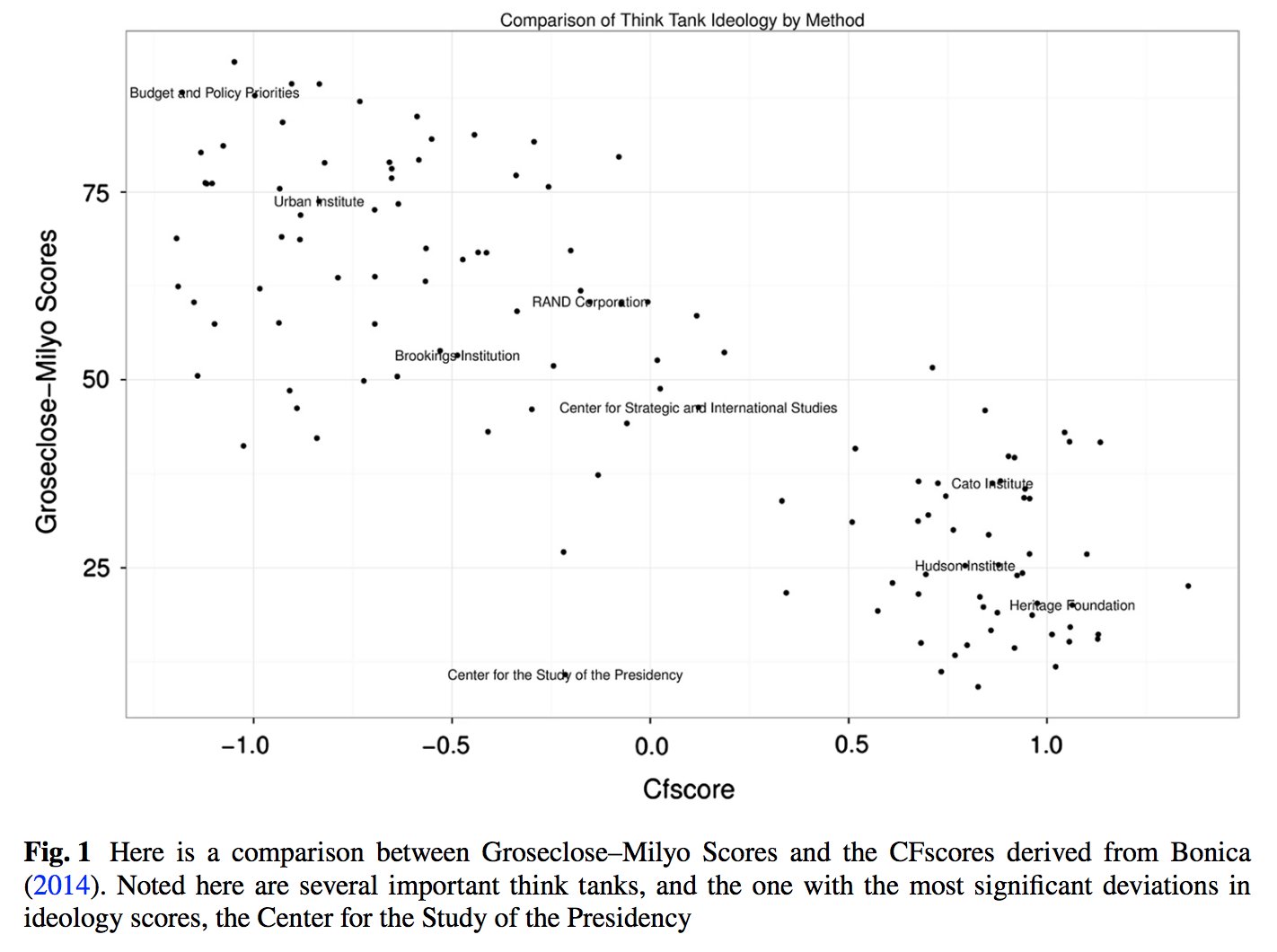
A new study has found that more extreme think tanks are more frequently cited in congressional floor speeches, but more moderate think tanks are called more often to testify.
Here is the abstract of the study, by Dr. Joshua Lerner:
Skirting the lines between academic, promotional and advocacy organizations, think tanks spend an inordinate amount of time and money attempting to influence policy debates, all the while being legally barred from lobbying. Think tanks, unlike interest groups, do not bring with them electoral constituencies to advocate on behalf of, so the ways in which they persuade legislators to adopt their opinions cannot simply be electoral in nature. Using a dataset of think tank citations from congressional floor speeches and committee testimony records, I compare the influence of think tanks based on a new measure of their ideologies and, in doing so, show that think tanks engage in strategic ideological positioning to maximize their influence. An additional hypothesis examined is the relationship between think tank members’ previous work experiences in government with the organizations’ overall prominence. By treating think tanks as strategic actors in legislative politics, I show that think tanks’ ideological positioning affects directly how members of Congress engage with them, both by citing them in floor speeches and in calling them to testify, with more extreme think tanks being cited more frequently in floor speeches and more moderate think tanks called more often to testify.
Dr. Lerner is a Postdoctural Research Fellow at Northwestern University Pritzker School of Law.
Subscribe to:
Posts (Atom)