Showing posts with label PIIE. Show all posts

Monday, August 8, 2016

Peterson Institute Fires Three Scholars Due to Conflicts of Interest

The Peterson Institute for International Economics (PIIE), one of the world's top economic think tanks, has recently fired three scholars for violating conflict of interest policies.  Here is more from the New York Times (in collaboration with the New England Center for Investigative Reporting), which has just published a two-part series highlighting the lack of independence at many major US think tanks:
Adam S. Posen, the president of the Peterson Institute, considered the world’s pre-eminent think thank on global economics, has a commanding view of the construction of the new headquarters for the American Enterprise Institute, as well as the main office of Brookings. From his grand office, he recently had a series of uncomfortable conversations with three scholars he had decided to let go.
After much internal debate, Mr. Posen decided to formally prohibit Peterson’s scholars from holding outside jobs that directly related to the field they wrote about on behalf of the think tank.
The three who had such outside engagements were terminated.
Mr. Posen noted that the change did not imply the researchers had done anything wrong. But tighter rules are needed, he said, to respond to a growing sense he shares with the Peterson board that the think tank industry must reassert its commitment to impartiality.

PIIE is reportedly updating its conflict-of-interest policies in the wake of recent reports shining a light on think tank independence.

Wednesday, February 17, 2016

Steven Rattner Describes Crowd at Peterson Institute

Here is how Steven Rattner describes the Peterson Institute for International Economics (PIIE):
A few days ago, I visited the shiny headquarters of the Peterson Institute for International Economics on “think tank row” in Washington — basically, the locker room of the Team Globalization and Free Trade cheering squad.
I was there to take part in a discussion of an old friend’s outstanding book on the subject, Steven R. Weisman’s “The Great Tradeoff: Confronting Moral Conflicts in the Era of Globalization.”
...Then I went rogue and uttered two blasphemous words: “Ross Perot.” He had a point, I said heretically, when he campaigned in 1992 against the landmark North American Free Trade Agreement, saying that it would result in a “giant sucking sound” of jobs headed south to Mexico.
A cool breeze drifted toward me.
As I looked out at my audience, I realized that the room was filled with winners — folks who, from all appearances, earned their livings from intellectual labor. Neither their jobs nor their wages were in jeopardy as countries ranging from Vietnam to Colombia became more competitive with us.

PIIE is certainly one of free trade and globalization's biggest proponents, and it always has been.

While at PIIE (formerly known as the Institute for International Economics), the scholar John Williamson coined the term "Washington Consensus," which is often seen as synonymous with globalization and neoliberalism.

Just last month the think tank came out with a study on the benefits of the Trans-Pacific Partnership (TPP), and bashed a competing study by Tufts University that did not support its findings.

Wednesday, February 3, 2016

PIIE Bashes Tufts for Its Competing Trade Study

The pro-traders at Peterson Institute for International Economics (PIIE) do not seem to like competition when it comes to free trade studies.

In a blog post, PIIE scholar Robert Lawrence defended his think tank's recent study on the Trans-Pacific Partnership (TPP), arguing that it is far superior than a Tufts University study on TPP that was just released but had very different findings.

Lawrence argues that the Tufts study, which estimates that TPP would reduce US income by 0.5%, reduce employment by almost half a million jobs, and increase income inequality, has faulty methodology.  Among other things, the PIIE study predicts that TPP would raise real incomes 0.5% by 2030.

Scholar Jared Bernstein, a former top economic adviser to Vice President Joe Biden and Senior Fellow at the Center on Budget and Policy Priorities (CBBP), defended the Tufts study at the National Press Club.

The PIIE study, entitled "The Economic Effects of the Trans-Pacific Partnership: New Estimates," was written by Peter Petri and Michael Plummer.  The Tufts study, entitled "Trading Down: Unemployment, Inequality and Other Risks of the Trans-Pacific Partnership Agreement," was written by Jeronim Capaldo and Alex Izurieta, with Jomo Kwame Sundaram.

The Tufts study cites a couple of PIIE studies in its reference section, and likewise, the PIIE study cites a couple of Tufts studies, including the most recent one.

Lawrence has been a Nonresident Senior Fellow at PIIE since 2001, and is the Albert L. Williams Professor of Trade and Investment at the John F. Kennedy School of Government at Harvard University.

Think Tank Watch is not taking sides, but we predict that both of the predictions in the study will be wrong.

Update:  Here is a piece in Salon entitled "TPP: Written By And For the Rich to Further Enrich Themselves at Our Expense," which blasts the PIIE report on TPP.

Tuesday, November 24, 2015

Think Tank Quickies (#200)

  • Center for a New American Security (CNAS) announces formation of ISIS Study Group.
  • CNAS announces new project on the future of ground forces.
  • Canadian Ambassador to US Gary Doer named Co-Chair of Canada Institute Advisory Board at Wilson Center. 
  • Wilson Center gets a new website in November.
  • Amb. Ryan Crocker named Distinguished Fellow at Wilson Center.
  • Wilson Center award honors Defense Secretary Ashton Carter.
  • Meet the Wilson Center's Polar Initiative.
  • AEI launches new app for iPad. 
  • Kirsten Madison, formerly at the White House, State Department, DHS, and US Senate, joins AEI as Resident Fellow and Deputy Director of Foreign and Defense Policy Studies.
  • AEI hires three for its Economic Policy Studies team: Eric Belasco, Benedic Ippolito, and Lawrence Mead.
  • Brookings appoints Janice Eberly and James Stock as co-editors of the Brookings Papers on Economic Activity (BPEA).
  • Brookings launches Brookings China Council to coincide with state visit of President Xi Jinping.
  • Brookings announces the Anne T. and Robert M. Bass Initiative on Innovation and Placemaking.  (Robert Bass is president of Keystone Group.)
  • CFR hires two new adjunct senior fellows: Esther Brimmer (formerly at the State Dept.) and Gordon Goldstein (Managing Director at Silver Lake). 
  • Presidential candidate Hillary Clinton speaks at CFR; Chris Christie to speak at CFR on Nov. 24.
  • Carnegie Endowment for International Peace (CEIP) appoints Tim Maurer for the think tanks new cyberpolicy initiative.
  • CEIP and Chicago Council on Global Affairs launch task force on US policy toward Russia, Ukraine, and Eurasia.
  • PIIE appoints Pedro Nicolaci da Costa (previously with Reuters & WSJ) to help with social media.
  • CSIS hires Jeff Rathke, a former Foreign Service officer, as Deputy Director and Senior Fellow of the Europe Program; also hires Lisa Sawyer Samp (formerly at DoD) for Int'l Security Program.
  • CSIS names nine new members to its Board of Trustees, including Erskine Bowles, William Daley, Stanley Druckenmiller, Martin Edelman, Elizabeth Holmes, Ron Kirk, Leon Panetta, Bob Schieffer, and Frances Townshend.
  • CSIS announces Marshall Program on Science and National Security.
  • Cato Institute names Robert Gelfond, CEO/Founder of Macro Quantitative Strategies, to its Board.
  • CAP launches national grassroots effort to raise awareness for nutrition assistance programs.
  • Atlantic Council holds Energy & Economic Summit in Istanbul, Turkey Nov. 18-20.
  • Atlantic Council, US Embassy Islamabad, and Meridian International Center announce 2015 Emerging Leaders of Pakistan (ELP) Fellows.
  • Atlantic Council presented annual Global Citizen Awards on Oct. 1 to Colombia President Juan Manuel Santos, European Central Bank President Mario Draghi, and Yu Long; Henry Kissinger accepts Distinguished Service Award, IMF's Christine Lagarde presents award to Draghi.
  • Atlantic Council and The Defense Entrepreneurs Forum (DEF) announce partnership.
  • Columnist Reihan Salam and Fresno Mayor Ashley Swearengin join NAF's Board of Directors.
  • Secretary of State John Kerry delivers Syria policy speech at USIP.
  • USIP lights headquarters blue for UN anniversary.
  • Henry Rowen, second president at RAND Corp., passes away.

Tuesday, September 8, 2015

Star Economist Peter Orszag Re-Joining Brookings

The Brookings Institution has just announced that Peter Orszag, former Director of the Office of Management and Budget (OMB) under President Obama, is rejoining the Economic Studies Program at Brookings as a Nonresident Senior Fellow effective September 8, 2015.  Here is more about his past history at the think tank:
Prior to leading CBO, Orszag served as the Joseph A. Pechman Senior Fellow and Deputy Director of Economic Studies [at Brookings], was the first director of The Hamilton Project, was director of the Retirement Security Project, and was a Co-Director of the Brookings-Urban Tax Policy Center.
Before his time at Brookings, Orszag served in the Clinton Administration, where he was Special Assistant to the President for Economic Policy, and prior to that a staff economist and then Senior Advisor and Senior Economist at the President’s Council of Economic Advisers.

Orszag also has affiliations with other think tanks.  For example, he currently serves on the Board of Directors of the Peterson Institute for International Economics (PIIE).  In the past, he has served as a Distinguished Visiting Fellow at the Council on Foreign Relations (CFR).

A couple months ago, Brookings announced that it has scooped up another all-star economist in Douglas Elmendorf, who has also re-joined Brookings after a stint in the Obama Administration as Director of the Congressional Budget Office (CBO).

Wednesday, September 2, 2015

WSJ Reminds Writers How to Cite Political Leanings of Think Tanks

The Wall Street Journal (WSJ) has just sent out a reminder to its writers on how to address various style and substance issues, including how to address the political leanings of think tanks.  Here is more:
"A reminder in this political season that we should be careful to classify the political leanings of the think tanks we mention in articles.  As noted in 2009, the designations 'liberal,' 'conservative,' and 'libertarian' are appropriate.  'Progressive' isn't.  If there is any doubt about what to call a think tank, double check with the Washington bureau."

In 2009, WSJ said it should "endeavor to classify the political leanings" of the think tanks its mentions in articles, to give readers a "reliable signpost."  The newspaper noted that the Center for Economic and Policy Research (CEPR), a liberal think tank, had recently been called "progressive" in a recent article.  WSJ said the word progressive is "a label some groups prefer because, after all, who doesn't like to be considered progressive?"  Here is more of what the WSJ said at that time:
It isn’t always easy to nail down the slant, if any, of individual think tanks. The conservative, liberal and libertarian designations as listed on Wikipedia are fairly reliable, but not infallible. The site also lists “centrist” groups, which we don’t consider a meaningful label, especially because some of those called centrist on the list are openly affiliated with political parties. Nonpartisan, if accurate, is better than “centrist.”  If other labeling is elusive, we can at least try to describe the think tank’s financing when it is appropriate: union-funded, or lawyer-funded,etc...

Think Tank watch is currently in the process of making a chart of dozens of think tanks and their political orientation compared to other think tanks.

In the meantime, one decent grouping of think tanks by political ideology can be found in this study by Fairness & Accuracy in Reporting (FAIR).  But, according to WSJ standards, many of the ideological groupings would not pass editorial muster.  For example, Brookings is listed as "centrist" when in reality, it is left-leaning.  And the Cato Institute is listed as "center-right" when a more accurate description is libertarian.

By the way, WSJ is not the only media outlet that is thinking about think tank ideology.  For example, in 2011, NPR said it often does a lousy job in identifying the background of think tanks.  And inevitably, some think tanks, such as the Peterson Institute for International Economics (PIIE), fight to have their ideology as obfuscated as possible.

Here is an article from 2011 entitled "Calculating The Ideologies of Powerful Think Tanks."  Among other things, it contains a list of the 20 most cited think tanks and where they stand on the political spectrum.  Here is another list of think tanks by ideology, including Canadian think tanks.

Another interesting question: Is there media bias against certain types of think tanks?
Tuesday, August 25, 2015

Thinks Tanks Have Deep Ties to Fortune 500 Companies

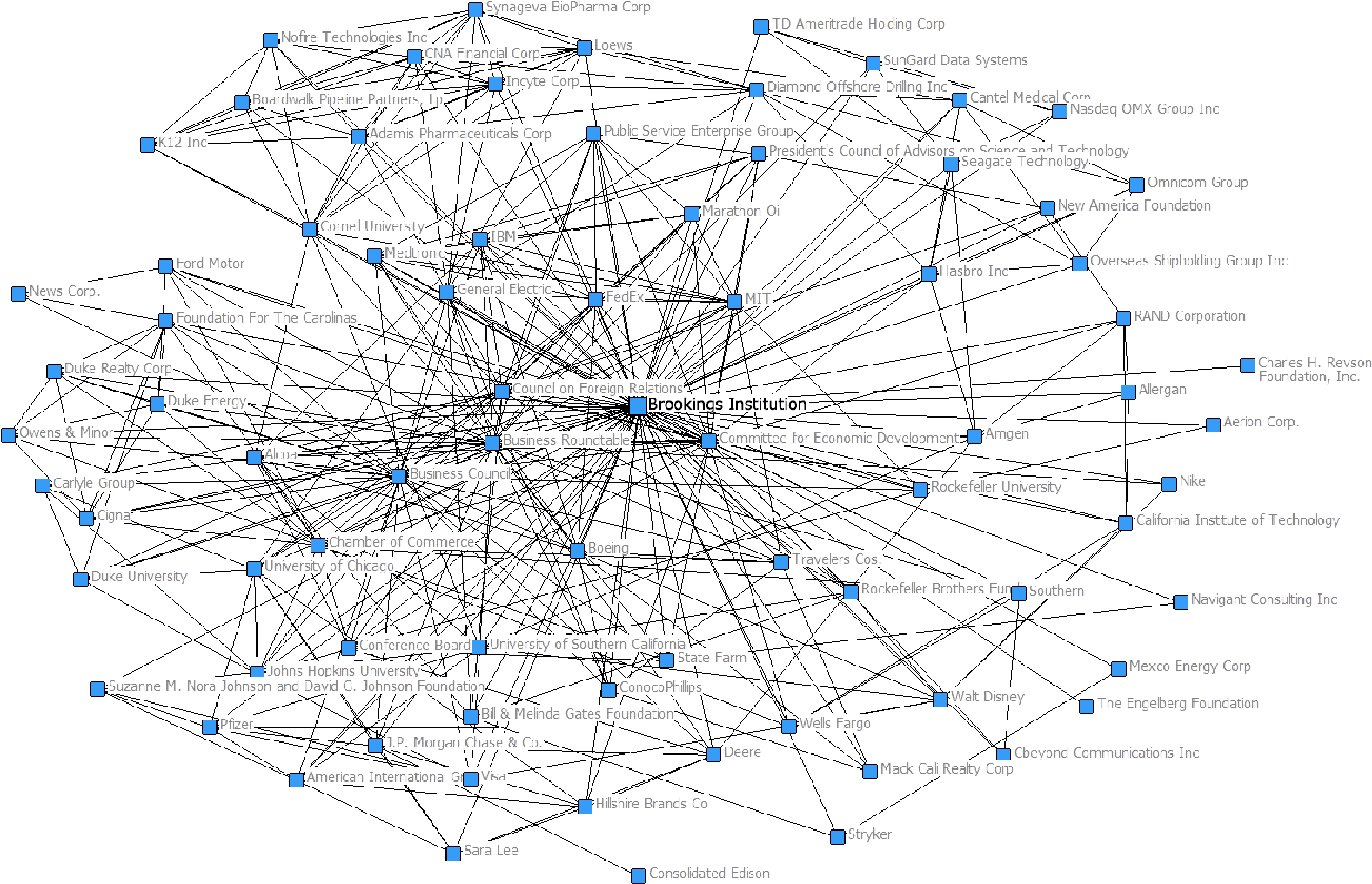
The University of California at Santa Cruz has put together a "Power Elite Database" showing the deep relationship between think tanks and corporations.  Here is an excerpt:
After the trustees of these 33 think tanks were added to the corporate network, we first looked at the relative centrality of Fortune-500 companies and think tanks in the combined database. (The six general business groups were excluded for the moment.) This analysis revealed that nine mainstream think tanks, such as the Center for Strategic and International Studies and the Institute for International Economics, and combined think tanks/policy-discussion groups, such as the Atlantic Council and Council on Foreign Relations, were among the 15 most central organizations in the network, with the ultraconservative and liberal think tanks that remained in the database more peripheral. To make this point with one good comparison, 38.3% of the trustees of The Brookings Institution, a prestigious centrist think tank that goes back to the 1920s, are Fortune 500 directors, as compared to only 9.1% of the trustees for the ultraconservative Heritage Foundation, which was founded in the early 1970s and is not considered to be reputable by most mainstream scholars.

A map of the corporate world's connection to think tank's can be found here.

The think tanks with the deepest connections to the most powerful corporations were:
  1. Brookings Institution
  2. Center for Strategic & International Studies (CSIS)
  3. Peterson Institute for International Economics (PIIE)
  4. Atlantic Council
  5. Council on Foreign Relations (CFR)
  6. Aspen Institute
  7. American Enterprise Institute (AEI)
  8. RAND Corporation
  9. National Bureau of Economic Research (NBER)
Among other things, the study concludes that its findings "cast doubt on any claim that think tanks are a unique independent sector."  It adds: "The idea that think tanks have a considerable degree of independence becomes even more questionable when it is added that they receive a significant share of their funding from wealthy individual donors and various foundations.  The authors of the study say that think tanks can basically be characterized as "subsidiaries of the corporate community."

The study goes on to note that between 2003 and 2011, 1,260 foundations gave $1.9 billion via 10,549 individual grants to the 41 most prominent think tanks.  Moreover, the 25 largest foundations accounted for over 71% of the total donations.