Showing posts with label CFR. Show all posts

Tuesday, May 9, 2017

CFR's Int'l Report Card: The World is in Steep Decline

The Council on Foreign Relations (CFR) has just released its third annual Report Card on International Cooperation, and things are not looking too good for planet Earth.  Here is more:

The third annual Report Card on International Cooperation sharply downgraded its assessment of efforts to mitigate the world’s most vexing problems in 2016 to a C-, falling from a B grade in 2015.
The Council of Councils, a Council on Foreign Relations (CFR) initiative comprising twenty-six major international policy institutes, surveyed the heads of member think tanks to evaluate the world’s performance on ten of the most important transnational challenges of 2016.
"Limited progress in combating climate change and advancing development in 2016 was overwhelmed by dismal failures of international efforts to promote global trade, resolve internal conflicts, and advance cyber governance," said CFR President Richard N. Haass. "Nationalist electoral campaigns throughout the world sailed to victory on promises to retreat from international commitments. This suggests 2017 will face even more fundamental challenges to international cooperation."

The full report card can be found here, and the methodology (including participating think tanks) can be found here.

Tuesday, September 27, 2016

Former CFR Scholar Axed From Trump Campaign

Here is more from Newsmax:
A foreign policy adviser to Donald Trump is reportedly stepping down from the campaign – and pushing back on allegations he had private communications with top Russian officials.
Carter Page called the allegations "just complete garbage" in an interview with the Washington Post, but said was taking a leave of absence because they were causing a "distraction."

U.S. intelligence officials were looking into whether Carter had met privately with Kremlin-aligned Russian figures while on a trip to Moscow in July, Yahoo News reported last Friday.

Carter Page was a fellow at the Council on Foreign Relations (CFR) and the director of the think tank's online roundtable of the Caspian Sea Region.  After his stint at CFR, he spoke at the think tank on several occasions.

Tuesday, November 24, 2015

Think Tank Quickies (#200)

  • Center for a New American Security (CNAS) announces formation of ISIS Study Group.
  • CNAS announces new project on the future of ground forces.
  • Canadian Ambassador to US Gary Doer named Co-Chair of Canada Institute Advisory Board at Wilson Center. 
  • Wilson Center gets a new website in November.
  • Amb. Ryan Crocker named Distinguished Fellow at Wilson Center.
  • Wilson Center award honors Defense Secretary Ashton Carter.
  • Meet the Wilson Center's Polar Initiative.
  • AEI launches new app for iPad. 
  • Kirsten Madison, formerly at the White House, State Department, DHS, and US Senate, joins AEI as Resident Fellow and Deputy Director of Foreign and Defense Policy Studies.
  • AEI hires three for its Economic Policy Studies team: Eric Belasco, Benedic Ippolito, and Lawrence Mead.
  • Brookings appoints Janice Eberly and James Stock as co-editors of the Brookings Papers on Economic Activity (BPEA).
  • Brookings launches Brookings China Council to coincide with state visit of President Xi Jinping.
  • Brookings announces the Anne T. and Robert M. Bass Initiative on Innovation and Placemaking.  (Robert Bass is president of Keystone Group.)
  • CFR hires two new adjunct senior fellows: Esther Brimmer (formerly at the State Dept.) and Gordon Goldstein (Managing Director at Silver Lake). 
  • Presidential candidate Hillary Clinton speaks at CFR; Chris Christie to speak at CFR on Nov. 24.
  • Carnegie Endowment for International Peace (CEIP) appoints Tim Maurer for the think tanks new cyberpolicy initiative.
  • CEIP and Chicago Council on Global Affairs launch task force on US policy toward Russia, Ukraine, and Eurasia.
  • PIIE appoints Pedro Nicolaci da Costa (previously with Reuters & WSJ) to help with social media.
  • CSIS hires Jeff Rathke, a former Foreign Service officer, as Deputy Director and Senior Fellow of the Europe Program; also hires Lisa Sawyer Samp (formerly at DoD) for Int'l Security Program.
  • CSIS names nine new members to its Board of Trustees, including Erskine Bowles, William Daley, Stanley Druckenmiller, Martin Edelman, Elizabeth Holmes, Ron Kirk, Leon Panetta, Bob Schieffer, and Frances Townshend.
  • CSIS announces Marshall Program on Science and National Security.
  • Cato Institute names Robert Gelfond, CEO/Founder of Macro Quantitative Strategies, to its Board.
  • CAP launches national grassroots effort to raise awareness for nutrition assistance programs.
  • Atlantic Council holds Energy & Economic Summit in Istanbul, Turkey Nov. 18-20.
  • Atlantic Council, US Embassy Islamabad, and Meridian International Center announce 2015 Emerging Leaders of Pakistan (ELP) Fellows.
  • Atlantic Council presented annual Global Citizen Awards on Oct. 1 to Colombia President Juan Manuel Santos, European Central Bank President Mario Draghi, and Yu Long; Henry Kissinger accepts Distinguished Service Award, IMF's Christine Lagarde presents award to Draghi.
  • Atlantic Council and The Defense Entrepreneurs Forum (DEF) announce partnership.
  • Columnist Reihan Salam and Fresno Mayor Ashley Swearengin join NAF's Board of Directors.
  • Secretary of State John Kerry delivers Syria policy speech at USIP.
  • USIP lights headquarters blue for UN anniversary.
  • Henry Rowen, second president at RAND Corp., passes away.

Thursday, November 19, 2015

Speaker Ryan's Top Foreign Policy Aides Come From Think Tanks

Here is more from the Washington Post:
Ryan will also be keeping the counsel of some of the Republican Party’s most recognized foreign policy experts, many of them veterans of the 2012 campaign in which he was Mitt Romney’s running mate.
That roster, according to Ryan aides, includes: Dan Senor, a prominent foreign policy adviser to the Romney campaign who previously worked as spokesman for the Coalition Provision Authority in Iraq; Elliott Abrams of the Council on Foreign Relations, who worked as a national security adviser to former President George W. Bush; and Eric Edelman, a former ambassador who served in Bush’s Defense Department.

Dan Senor used to be an Adjunct Senior Fellow for Middle East Studies at the Council on Foreign Relations (CFR).  He also established a think tank called Foreign Policy Initiative, along with William Kristol and Robert Kagan.

As the article mentions, Elliott Abrams works at CFR, where he is a Senior Fellow for Middle East Studies.

Eric Edelman, a Distinguished Fellow at the Center for Strategic and Budgetary Assessments (CSBA).  Among other things, he is also a member of the Board of Directors at the US Institute of Peace (USIP).

Here is a previous Think Tank Watch post on Ryan's deep connection to think tanks.

Monday, November 16, 2015

Think Tank Quickies (#197)

  • New book on Asian think tanks by Erin Zimmerman.
  • A master's in international relations can lead to the prestigious but fiercely competitive career in international think tanks.
  • Panel launched by CIGI and Chatham House urge new social compact on Internet privacy.
  • Military science fiction from Atlantic Council's Art of Future Warfare project. 
  • Rethinking T20: Think tanks, ideas and innovation in foreign policy, via Juan Luis Manfredi.
  • Lee Fang story: SEC nominee to oversee Wall Street (Hester Maria Peirce) works at think tank dedicated to blocking regulation (Mercatus Center).
  • Netanyahu escapes CAP event without any fireworks, via FP's John Hudson.
  • Cato on Instagram: A behind-the-scenes look at life in a libertarian think tank.
  • Rethinking Russia launches new research project to map think tanks that study Russia.
  • Yahoo News report on new CFR Task Force report "eliminates reference" to every single woman involved.
  • Third Way takes home two pumpkin carving trophies (h/t David Slavick).

Friday, September 25, 2015

Women Leadership Positions Rise at CFR & CNAS, Fall at CSIS

If you are a women looking to make a career out of think tanks, you may want to pick your think tank carefully.

Women have been increasing their ranks in leadership positions at some of the US's top think tanks, but others have seen a decline in top spots for women in recent years.

Micah Zenko and Amelia Mae Wolf of the Council on Foreign Relations (CFR) have outlined recent findings in a piece in Foreign Policy entitled "Leaning From Behind":
Data gathered from publicly available sources - on what we subjectively considered the top US think tanks working on foreign policy issues four years ago - reveals that women now comprise 24 percent of people working in policy-related positions and 33 percent of total leadership staff.  The prevalence of women in these nine think tanks has increased by less than 1 percent annually in the past four years.
For this analysis, "policy-related" positions were classified as leadership roles (directors, presidents, and fellows) within departments focused on foreign policy, and "total leadership staff" included senior positions in non-policy roles such as human resources, development, and communications, which play an essential role in developing and implementing think tank programs.

The authors go on to say, among other things, that foreign policy and national security communities are "missing out on a wealth of expertise that could provide alternative thinking and policy options" by not hiring enough women.

Also noted is the idea that women are better for preventing war and corruption, and help with the economic competitiveness of a country:
The inclusion of women is proven to have enormous benefits for national security and foreign policy. The International Peace Institute found that women’s participation in peace negotiations, whether holding seats at the negotiating table or as political leaders, benefits the longevity of a peace agreement, making it 20 percent more likely to last at least two years and 35 percent more likely to last 15. This is particularly relevant for the United States, which will have spent an estimated $4-6 trillion on the wars in Iraq and Afghanistan, and is engaged in a $9.9 million per-day open-ended air war against the Islamic State. Other studies have found that a higher number of women in senior government positions is correlated with lower levels of corruption and economic competitiveness of a country.

The authors call on senior administrators at think tanks to make it a priority to increase the percentage of female experts to 50 percent.

They cite the "women and foreign policy" programs at several think tanks as positive developments, and say that males are "empowered to influence change" by refusing to speak on all-male panels (something that FP Group CEO/Editor David Rothkopf has done), or responding to media/speaking requests with suggestions for alternative female speakers.

Based on the data that Think Tank Watch has reviewed, the Council on Foreign Relations is the first major foreign policy think tank to have at least 50% of its leadership roles given to women.

Interestingly, the Center for Strategic and International Studies (CSIS) was the only think tank in the study that had a decline in policy-related leadership positions given to women.  Overall leadership positions held by women at CSIS remained stagnant from 2011 to 2015.

The Stimson Center was the only think tank in the study that had a decline of women in leadership positions (overall) from 2011 to 2015.

A chart comparing women's representation at major foreign policy think tanks from 2011 vs. 2015 can be found here.

Here is a previous Think Tank Watch post on women in think tanks.

Thursday, September 17, 2015

Carly Fiorina's Quiet Adventures in Think Tank Land

Carly Fiorina, the 2016 Republican presidential candidate who got rave reviews at yesterday's presidential debate, has had an under-the-radar relationship with a handful of think tanks.

For example, the former Chairman and CEO of Hewlett-Packard has been a Senior Adviser at the Center for Strategic and International Studies (CSIS).

Among other things, she was tapped to be a member of CSIS's Executive Council on Development.  Earlier this year she gave a speech at CSIS for the "Smart Women, Smart Power" initiative.  In 2013 she gave a speech at the think tank at a forum on innovation for government effectiveness.

Of course, CSIS is not the only think tank that Carly Fiorina has a connection to.  Earlier this year, Fiorina gave a keynote address at the annual dinner of the conservative think tank Competitive Enterprise Institute (CEI).

Ms. Fiorina was also the Chair of the Board of Directors of Technology Policy Institute (TPI), a Washington, DC-based think tank focusing on the economics of innovation and technological change.

Following are a few things that other think tanks have put said about Fiorina:

  • Here is what the Council on Foreign Relations (CFR) has put together on the foreign policy positions of Carly Fiorina.
  • Marc Thiessen of American Enterprise Institute (AEI) writes how Carly Fiorina is on the rise.
  • The Heritage Foundation said earlier this year that no other potential 2016 GOP candidate was tougher on Hillary Clinton than Carly Fiorina at the Conservative Political Action Conference (CPAC).
  • Brookings Institution scholar John Hudak has said that Fiorina probably has more potential as a vice presidential candidate, and could possibly be tapped as Secretary of Veterans Affairs.

Think Tank Watch prediction: After yesterday's performance, don't be surprised if Fiorina starts making her way around the think tank circuit more regularly.

Tuesday, September 8, 2015

Star Economist Peter Orszag Re-Joining Brookings

The Brookings Institution has just announced that Peter Orszag, former Director of the Office of Management and Budget (OMB) under President Obama, is rejoining the Economic Studies Program at Brookings as a Nonresident Senior Fellow effective September 8, 2015.  Here is more about his past history at the think tank:
Prior to leading CBO, Orszag served as the Joseph A. Pechman Senior Fellow and Deputy Director of Economic Studies [at Brookings], was the first director of The Hamilton Project, was director of the Retirement Security Project, and was a Co-Director of the Brookings-Urban Tax Policy Center.
Before his time at Brookings, Orszag served in the Clinton Administration, where he was Special Assistant to the President for Economic Policy, and prior to that a staff economist and then Senior Advisor and Senior Economist at the President’s Council of Economic Advisers.

Orszag also has affiliations with other think tanks.  For example, he currently serves on the Board of Directors of the Peterson Institute for International Economics (PIIE).  In the past, he has served as a Distinguished Visiting Fellow at the Council on Foreign Relations (CFR).

A couple months ago, Brookings announced that it has scooped up another all-star economist in Douglas Elmendorf, who has also re-joined Brookings after a stint in the Obama Administration as Director of the Congressional Budget Office (CBO).

Tuesday, August 25, 2015

Thinks Tanks Have Deep Ties to Fortune 500 Companies

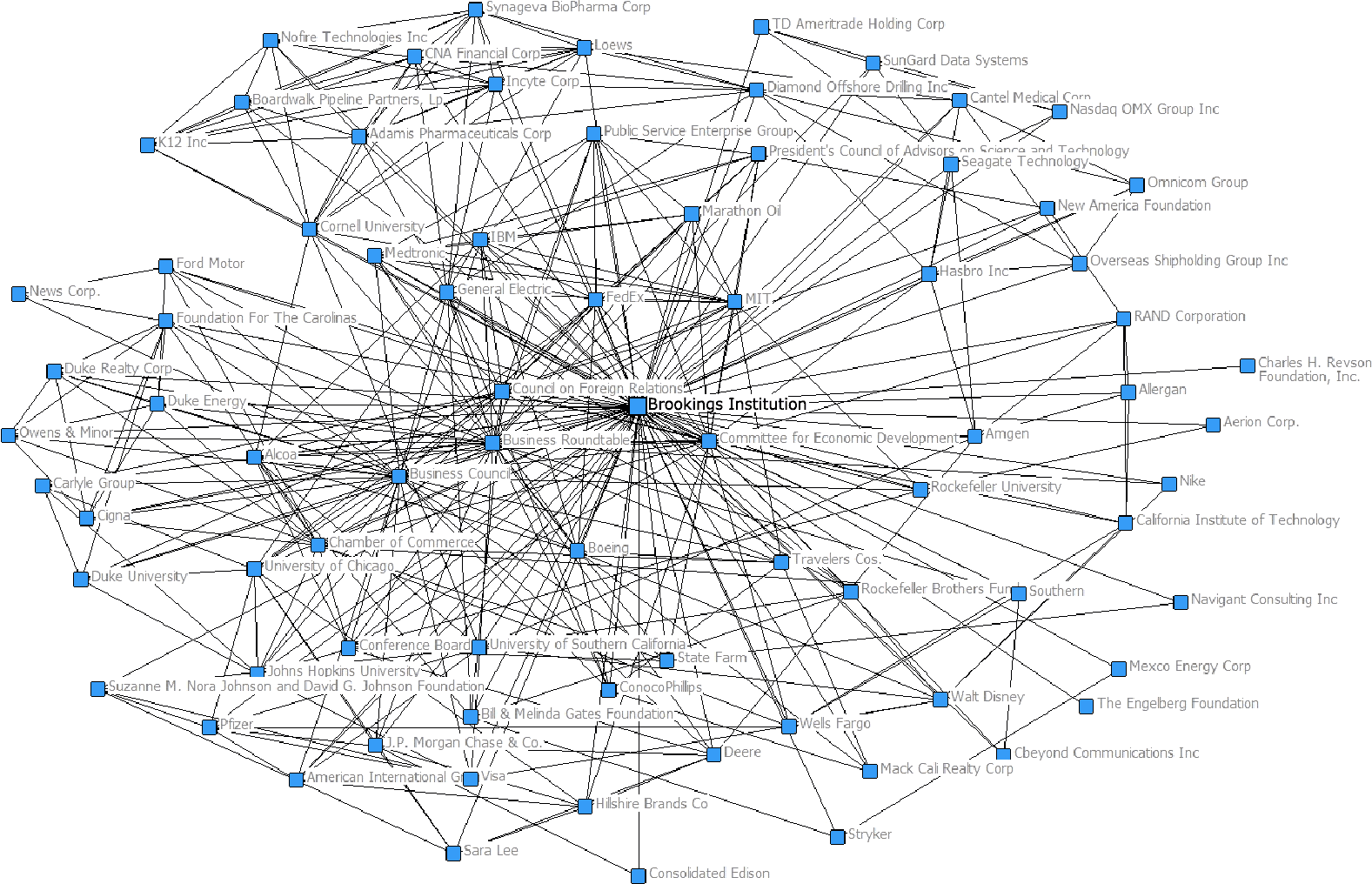
The University of California at Santa Cruz has put together a "Power Elite Database" showing the deep relationship between think tanks and corporations.  Here is an excerpt:
After the trustees of these 33 think tanks were added to the corporate network, we first looked at the relative centrality of Fortune-500 companies and think tanks in the combined database. (The six general business groups were excluded for the moment.) This analysis revealed that nine mainstream think tanks, such as the Center for Strategic and International Studies and the Institute for International Economics, and combined think tanks/policy-discussion groups, such as the Atlantic Council and Council on Foreign Relations, were among the 15 most central organizations in the network, with the ultraconservative and liberal think tanks that remained in the database more peripheral. To make this point with one good comparison, 38.3% of the trustees of The Brookings Institution, a prestigious centrist think tank that goes back to the 1920s, are Fortune 500 directors, as compared to only 9.1% of the trustees for the ultraconservative Heritage Foundation, which was founded in the early 1970s and is not considered to be reputable by most mainstream scholars.

A map of the corporate world's connection to think tank's can be found here.

The think tanks with the deepest connections to the most powerful corporations were:
  1. Brookings Institution
  2. Center for Strategic & International Studies (CSIS)
  3. Peterson Institute for International Economics (PIIE)
  4. Atlantic Council
  5. Council on Foreign Relations (CFR)
  6. Aspen Institute
  7. American Enterprise Institute (AEI)
  8. RAND Corporation
  9. National Bureau of Economic Research (NBER)
Among other things, the study concludes that its findings "cast doubt on any claim that think tanks are a unique independent sector."  It adds: "The idea that think tanks have a considerable degree of independence becomes even more questionable when it is added that they receive a significant share of their funding from wealthy individual donors and various foundations.  The authors of the study say that think tanks can basically be characterized as "subsidiaries of the corporate community."

The study goes on to note that between 2003 and 2011, 1,260 foundations gave $1.9 billion via 10,549 individual grants to the 41 most prominent think tanks.  Moreover, the 25 largest foundations accounted for over 71% of the total donations.

Think Tank Quickies (#187)

  • China-backed think tank (Madariaga-College of Europe Foundation) exits Brussels.
  • Chinese defense think tanks face enormous challenges.
  • India's most influential think tanks.
  • Leader of Korea's ruling Saenuri Party, Rep. Kim Moo-sung to visit think tanks such as Wilson Center and Brookings during 7-day trip.
  • Conservative think tanks wants the White House Science Czar's private emails. 
  • Guyana needs more think tanks.
  • Renaming a think tank in Singapore.
  • Ideological divide between US and Russian think tanks? 
  • Jimmy Carter's grandson to take over as chairman of Carter Center.
  • What's the point of development think tanks?
  • CFR map on vaccine-preventable outbreaks.
  • Who says the summer doesn't have cool think tank events?  See Hudson Institute's August 3 event Cyber-Enabled Economic Warfare - An Evolving Challenge, and Atlantic Council's July 29 event Rethinking Commercial Espionage.

Thursday, July 30, 2015

Powerful Think Tanker Sells Iran Deal on Capitol Hill


Think tanker Nicholas Burns, a top diplomat in the Bush Administration, has been tapped by House Minority Leader Nancy Pelosi (D-CA) to sell the recently reached Iran nuclear deal to Capitol Hill.  Here is more from Politico:
A former top diplomatic appointee in the administration of President George W. Bush will help sell the Iranian nuclear deal to House Democrats this week.
Nicholas Burns, who served as undersecretary of state for political affairs from 2005 to 2008, will brief the caucus on Wednesday at the invitation of Minority Leader Nancy Pelosi (D-Calif.). Burns, who helped Bush design the current detente with Iran, is a strong proponent of the nonproliferation deal.

Mr. Burns is a Director of the International Advisory Board at the Atlantic Council and sits on the board at the Council on Foreign Relations (CFR).  He is also a member of the board at Harvard's Belfer Center.  He also serves on the Panel of Senior Advisors at the Royal Institute of International Affairs (Chatham House). He was previously a public policy scholar at the Wilson Center.

In related news, Ellen Laipson, President and CEO of the Stimson Center, has just penned a piece entitled "Iran Deal Debate Highlights Think Tanks' Role in US Policy."

Nearly every major foreign policy think tank in the US has weighed in on the Iran deal, and many are working behind the scenes to influence its outcome in Congress and elsewhere.