Showing posts with label think tank studies. Show all posts

Tuesday, May 21, 2019

Top 3 Conservative Think Tanks Collectively Larger than Combined Budget of CRS & CBO

Here is more from E.J. Fagan:

Congress is more polarized and has less capacity to process complex information than ever. These trends are related. As Congress cut the budgets of its own internal think tanks – CRS and CBO – it began to rely more heavily on  party-aligned think tanks. This change makes it more difficult for members and leadership to build consensus and solve policy problems for their constituents.
My work examines the congressional activities of the six largest (by expenditures) party-aligned think tanks. On the right, these include the Heritage Foundation, American Enterprise Institute, and Cato Institute. On the left, they are the Center for American Progress, New America, and Center on Budget and Policy Priorities. Collectively, these six institutions have grown to a massive size, while Congress’s internal think tanks, the CBO and CRS, are slowly shrinking. The below figure shows how rapidly these six think tanks have grown since 2001. The three conservative think tanks are collectively larger than the combined budget of the CBO and CRS. The three progressive think tanks, which began the 2000s as tiny blips on the screen, now spend over $100 million collectively.
As they have grown, these party-aligned think tanks have become more influential in Congressional debates. One way that I measure the changing influence of think tanks over time is to observe how frequently they testify in hearings. The figure below charts the number of witnesses from the six think tanks per hearing against the staff witnesses from the CBO, CRS, and OTA. The two trends are mirror images of each other. When Congress cut the budgets of its analytical organizations in the mid-90s, there was a subsequent explosion in think tank witnesses. While this explosion subsided after the 104th Congress, a new equilibrium was established for much of the late-90s and early 2000s. Finally, the series accelerates again in the mid-2000s, as the analytical organization budgets suffered further cuts.

E.J. Fagan is a Ph.D. student at the University of Texas at Austin.

Think Tank Watch should note that the RAND Corporation by itself has a budget that is much larger than the CBO and CRS combined.
Thursday, September 6, 2018

Think Tank Quickies (#324)

  • Qatar used think tanks to cheat its way to World Cup 2022?
  • Chart: Number of employees at US think tanks making more than $100K.
  • Behind a major think tank's (Aspen Institute) new fund for promising problem solvers.
  • Think tanks fill knowledge gap of politics.
  • Vibe of "Fortune Brainstorm Tech": Think tank in the Rockies. 
  • Brookings grants for productivity studies. 
  • Capitol Hill comes to the Hoover Institution. 
  • Foreign spies at Aspen National Security Forum? 
  • Think tankers need to hustle: The rise of the promotional intellectual. 
  • RAND study: Marines lead all services in binge drinking, sex partners.

Tuesday, September 12, 2017

Think Tanks Preparing Studies on War With North Korea

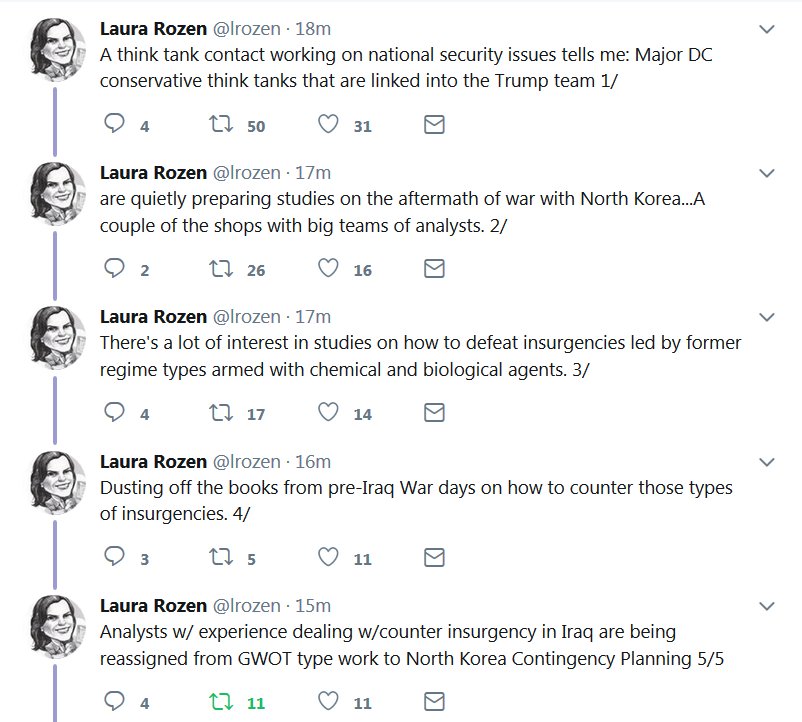
Laura Rozen, a diplomatic correspondent at Al-Monitor, says that conservative think tanks aligned with President Donald Trump are "quietly preparing studies on the aftermath of war with North Korea."

Here is a thread from Twitter (via Ben Norton):


Another tweet says that she is "not entirely sure" which think tanks are preparing the studies, but "got the impression [they] might be linked up with" the Institute for the Study of War (ISW) and its affiliates.

ISW is a Washington, DC-based think tank founded in 2007 by Kimberly Kagan, a strong supporter of the controversial "surge" strategy in Iraq.

Think Tank Watch should note that a number of conservative think tanks track and write reports about North Korea, including the Heritage Foundation and American Enterprise Institute (AEI).  [A number of liberal think tanks also track North Korea, including the Brookings Institution and Center for American Progress.]

Here is a recent Think Tank Watch piece about the role some think tankers are playing behind-the-scenes to negotiate peace with North Korea.

Tuesday, May 9, 2017

CFR's Int'l Report Card: The World is in Steep Decline

The Council on Foreign Relations (CFR) has just released its third annual Report Card on International Cooperation, and things are not looking too good for planet Earth.  Here is more:

The third annual Report Card on International Cooperation sharply downgraded its assessment of efforts to mitigate the world’s most vexing problems in 2016 to a C-, falling from a B grade in 2015.
The Council of Councils, a Council on Foreign Relations (CFR) initiative comprising twenty-six major international policy institutes, surveyed the heads of member think tanks to evaluate the world’s performance on ten of the most important transnational challenges of 2016.
"Limited progress in combating climate change and advancing development in 2016 was overwhelmed by dismal failures of international efforts to promote global trade, resolve internal conflicts, and advance cyber governance," said CFR President Richard N. Haass. "Nationalist electoral campaigns throughout the world sailed to victory on promises to retreat from international commitments. This suggests 2017 will face even more fundamental challenges to international cooperation."

The full report card can be found here, and the methodology (including participating think tanks) can be found here.

Monday, February 1, 2016

Chocolate Milk-Gate & How Not to Roll Out a Think Tank Study

For those thinks tanks who are about to release an important study this year, we only have one piece of advice for you: Do not follow in the footsteps of the University of Maryland.  Here is more from the Washington Post:

The bulletin atop a University of Maryland news release was provocative: “Concussion-related measures improved in high school football players who drank new chocolate milk, U-Md. study shows.”
But an update posted below that finding in late December added a backpedaling caveat rarely seen from a major research university: “This press release refers to study results that are preliminary and have not been subjected to the peer review scientific process.”
The December news release touting a beverage called Fifth Quarter Fresh has become a significant embarrassment in College Park as officials scramble to learn how and why it was published prematurely. The beverage is produced by a small western Maryland company that helped fund the study, through a program based at U-Md. that connects businesses with universities for product-development research.

Universities and think tanks receive corporate funding all the time (including money for corporate-sponsored research), but chocolate milk being good for concussions?  Really?!