The liberal think tank Economic Policy Institute (EPI) has developed a Family Budget Calculator that tallies the annual income needed to support a family of four to cover the cost of seven needs: transportation, food, housing, child care, taxes, and "other necessities."
Here is a chart from the Washington Post comparing the 10 largest US metro areas by population (including Washington, DC - the home of hundreds of think tanks) showing the annual cost of living.
The average annual cost for a family of four to live in Washington, DC - the home of 396 think tanks and counting - is $106,493. The average think tank salary is somewhere between $47,000 and $66,000.
It shows that in Washington, DC, if you work at a think tank and are the sole breadwinner with a family, you basically will not be able to live in Washington (unless you are at the upper echelons). Happy think tanking!
Friday, December 18, 2015
Thursday, December 17, 2015
Do Think Tanks Make Americans Skeptical About Climate Change?
Do think tanks contribute to the fact that so many Americans are skeptical about climate change? Here is more from a new Yale study, as detailed in the Washington Post:
Here is a previous Think Tank Watch piece on whether new think tanks are needed to address climate change.
Climate change has long been a highly polarizing topic in the United States, with Americans lining up on opposite sides depending on their politics and worldview. Now a scientific study sheds new light on the role played by corporate money in creating that divide.
The report, a systematic review of 20 years’ worth of data, highlights the connection between corporate funding and messages that raise doubts about the science of climate change and whether humans are responsible for the warming of the planet. The analysis suggests that corporations have used their wealth to amplify contrarian views and create an impression of greater scientific uncertainty than actually exists.
“The contrarian efforts have been so effective for the fact that they have made it difficult for ordinary Americans to even know who to trust,” said Justin Farrell, a Yale University sociologist and author of the study, released on Monday in the peer-reviewed journal, Proceedings of the National Academy of Science.
Numerous previous studies have examined how corporate-funded campaigns have helped shape individual views about global warming. But the Yale study takes what Farrell calls the “bird’s-eye view,” using computer analytics to systematically examine vast amounts of printed matter published by 164 groups—including think-tanks and lobbying firms—and more than 4,500 individuals who have been skeptical of mainstream scientific views on climate change.
The study analyzed the articles, policy papers and transcripts produced by these groups over a 20-year period. Then it separated the groups that received corporate funding from those that did not.
The results, Farrell said, revealed an “ecosystem of influence” within the corporate-backed groups. Those that received donations consistently promoted the same contrarian themes—casting doubt, for example, on whether higher levels of man-made carbon-dioxide in the atmosphere were harmful to the planet. There was no evidence of such coordination among the non-funded groups.
Here is a previous Think Tank Watch piece on whether new think tanks are needed to address climate change.
President of CAP Wants Half-Female Cabinet for Hillary
Neera Tanden, the President of the liberal think tank Center for American Progress (CAP) who has close ties to Hillary Clinton, is calling for a large percentage of females to hold Cabinet positions when the new US president takes office in 2017. Here is more:
If half of the members of Canada’s Cabinet can be female, why couldn’t we get to 50 percent, too? We’re talking about finding, at minimum, 11 women out of the almost 160 million in this country who could serve in the Cabinet at once...
What would that Cabinet look like? It’s not hard to imagine that, in 2017, a Michèle Flournoy, former undersecretary of defense for policy, could become the first female defense secretary, or a Sheryl Sandberg, COO of Facebook, could become the first woman as Treasury secretary. For a Republican Cabinet, New Mexico Gov. Susana Martinez would be more than qualified to lead the Justice Department, and South Carolina Gov. Nikki Haley would be a highly capable choice to head the Department of Homeland Security.CAP is known to have greatly influenced a number of policies in the Obama Administration, and will likely have a massive influence on a Hillary administration should she become president.
Will Snapping be the New Clapping at Think Tanks in 2016?
This from the New York Times:
Think Tank Watch is happy to report that in the conservative, stuffy, and button-down atmosphere of Washington, snapping is not being used at most think tanks.
But should any snapping take place, please report to Think Tank Watch immediately.
In a culture ruled by the instant feedback loop of retweets, likes and hearts, the snap (and by “snap” we mean the old-fashioned act of brushing the thumb and middle finger against one another in an effort to make a popping sound) is more often being used as a quiet signal of agreement or appreciation in conferences, university auditoriums, poetry slams and even at dinner tables.
As opposed to a single snap, often affected with the sassy wag of a hand and the utterance, “Oh, snap!” to signify that someone has just been stung by a verbal zinger, snapping repeatedly for a sustained several seconds is a way for audience members and classroom denizens to express approval without completely disrupting a lecture, speech or performance.
Think Tank Watch is happy to report that in the conservative, stuffy, and button-down atmosphere of Washington, snapping is not being used at most think tanks.
But should any snapping take place, please report to Think Tank Watch immediately.
Think Tank Quickies (#202)
- Justin Sandefur of CGD: "Biggest lesson so far in think tank land: The returns to being opinionated & sounding authoritative are disturbingly high."
- Creator of new ranking of influential think tanks working to fix flaws in ranking.
- Libertarian Niskanen Center started new Center for Climate Science to scrutinize deniers' arguments.
- Wonky holiday gear from Brookings.
- Book: Think tanks and the Economic Counter-revolution, 1931-83.
- Tim Carney: Liberals at liberal think tank thinks liberal think tank should only work with other liberal think tanks.
- Public Accountability Initiative: Oil tanks - oil industry ties behind think tanks' push to repeal the crude oil export ban.
- Influence of think tanks on the TTIP debate (in Dutch).
- UK's Independent: Lord Lawson's climate think tank under review after adviser offers to write paper for sham oil company.
- Can think tanks use Google's best practices for fostering creativity and innovation?
- New think tank to research freelancing (Centre for Research on Self-Employment, or CRSE).
- The Economist: Thoughtful centrists have begun urging Democrats to prepare for divided government, notably at a recent meeting at Third Way.
- Ted Cruz rating near-perfect on Heritage Action scorecard.
- Washington Post: American academics, particularly those who need access to China to conduct research, have to watch their words, because if China disapproves of their views it will not let them in.
- Brookings scholar J.M. Berger suggests other think tankers underestimated Islamic State (ISIS), but he did not.
- Nikkei runs one of Japan's major think tanks, the Japan Center for Economic Research.
- In conjunction with the Open Technology Institute at New America Foundation, Travis Moore launches new technology fellowship known as "TechCongress."
- Several think tankers on the WSJ's CEO Council "participating guest" list for 2015, including Martin Baily (Brookings), Doris Meissner (Migration Policy Institute), Danielle Pletka (AEI), Strobe Talbott (Brookings), Neera Tanden (CAP), and John Podesta (CAP founder).
Monday, December 14, 2015
New List: 50 Most Influential Think Tanks
TheBestSchools.org has just released a new list of the 50 most influential think tanks in the United States, compiled using a set of criteria that no other entity has done in the past.
The rankings are based on the popularity of a think tank's website, average yearly revenue of a think tank, average number of printed media references per year by outside organizations, and the number of categories in which a think tank was ranked by the University of Pennsylvania.
Think Tank Watch should point out that the list from TheBestSchools.org includes a number of institutions that are not generally considered think tanks.
Here is a list of the top 25:
Here is how the latest University of Pennsylvania think tank rankings have ranked what it considers to be the top think tanks.
Over the years there have been a number of different ways that people and organizations have ranked think tanks, including this one by the Center for Global Development (CGD).
Here is a ranking of think tanks by media citations from Fairness & Accuracy in Reporting (FAIR).
Update: Alejandro Chafuen, President of the Atlas Economic Research Foundation, has already found major mistakes in TheBestSchools.org think tank rankings.
The rankings are based on the popularity of a think tank's website, average yearly revenue of a think tank, average number of printed media references per year by outside organizations, and the number of categories in which a think tank was ranked by the University of Pennsylvania.
Think Tank Watch should point out that the list from TheBestSchools.org includes a number of institutions that are not generally considered think tanks.
Here is a list of the top 25:
- Belfer Center for Science and International Affairs
- Earth Institute
- Heritage Foundation
- Human Rights Watch
- Kaiser Family Foundation
- Council on Foreign Relations (CFR)
- Brookings Institution
- Cato Institute
- Ludwig von Mises Institute
- American Enterprise Institute (AEI)
- RAND Corp.
- Center for American Progress (CAP)
- Alan Guttmacher Institute
- Center on Budget and Policy Priorities (CBBP)
- National Bureau of Economic Research (NBER)
- Electronic Privacy Information Center
- Peterson Institute for International Economics (PIIE)
- Center for Strategic and International Studies (CSIS)
- Urban Institute
- Economic Policy Institute (EPI)
- Aspen Institute
- Wilson Center
- Hoover Institution
- Manhattan Institute for Policy Research
- Center for Immigration Studies
Here is how the latest University of Pennsylvania think tank rankings have ranked what it considers to be the top think tanks.
Over the years there have been a number of different ways that people and organizations have ranked think tanks, including this one by the Center for Global Development (CGD).
Here is a ranking of think tanks by media citations from Fairness & Accuracy in Reporting (FAIR).
Update: Alejandro Chafuen, President of the Atlas Economic Research Foundation, has already found major mistakes in TheBestSchools.org think tank rankings.
Thursday, December 10, 2015
Professor Interrogated by Iran About Inner Workings of Think Tank

Haleh Esfandiari, a scholar who spent more than 100 days in solitary confinement in Iran's Evin Prison in 2007, says that she was interrogated by the Iranians about her work at the Washington, DC-based think tank Wilson Center. Here is more from The Washington Diplomat:
Haleh Esfandiari is perhaps best known for spending 105 days in solitary confinement in Iran’s notorious Evin Prison in 2007, but it was her highly respected work as director of the Middle East Program at the Wilson Center in D.C. that put her behind bars.
Not that the Iran-born professor, author and think tank scholar did anything wrong. Quite the contrary, she had simply spent a lifetime studying, dissecting and challenging Middle Eastern politics, culture and policy. The Iranian government, however, saw her as part of a subversive U.S. plot to overthrow the clerical regime.
Iranian intelligence spent months interrogating Esfandiari on the inner workings of the Wilson Center and her connections to opposition activists inside Iran. Back home, the scholar’s friends and family mobilized a high-profile campaign to get her released.
Esfandiari, a former journalist in Iran who founded the Wilson Center’s Middle East Program in 1997, was eventually released and wrote a book about her experience titled “My Prison, My Home: One Woman’s Story of Captivity in Iran.” The book was published in 2009 and Esfandiari went back to the Wilson Center to resume her leadership of the Middle East Program.
Here is the Wilson Center biography of Dr. Esfandiari, which notes that she is no longer the Director of the Middle East Program at the think tank.
Head of New AIIB Invites US to Join Bank at Brookings
Jin Liquan, president-designate of the new China-led Asian Infrastructure Investment Bank (AIIB), formally invited the United States to join the bank during a talk at the Brookings Institution.
Here is how the New York Times framed the invitation:
He made the comment at this event at Brookings.
Here is what Brookings scholar David Dollar has written about the AIIB. Here is what Brookings scholar Jonathan Pollack says about how the US will respond to AIIB's expanding membership. Here is what Brookings scholar Thomas Wright says about AIIB. And here is what Brookings fellow Philippe Le Corre says about AIIB.
Here is how the New York Times framed the invitation:
He [Jin Liquan] is not giving up on the United States, even if his chances are remote. "We have a standing invitation" for the United States to join the bank, Mr. Jin said, during an appearance at the Brookings Institution. "Anytime you think you are ready, pick up the phone, give me a ring."
He made the comment at this event at Brookings.
Here is what Brookings scholar David Dollar has written about the AIIB. Here is what Brookings scholar Jonathan Pollack says about how the US will respond to AIIB's expanding membership. Here is what Brookings scholar Thomas Wright says about AIIB. And here is what Brookings fellow Philippe Le Corre says about AIIB.
Wednesday, December 9, 2015
CSIS President Has Warned of Cyber Pearl Harbor Since 90's
Dr. John Hamre, President and CEO of the Strategic and International Studies (CSIS), is warning of a cyber Pearl Harbor, saying that hostile foreign intelligence and militaries are prepared to wage war now. Here is more from Dr. Hamre, who reflects on the term he had used for nearly two decades:
The full piece in Politico can be read here. And here is a piece from 1997 documenting Hamre's comments on an electronic Pearl Harbor when he was at the Department of Defense.
Here is a recent Think Tank Watch piece on why reading think tank reports can actually harm your company. It notes that a number of think tanks have been victims of numerous cyber attacks.
In November 1997 I was asked to testify at a Senate hearing concerning the growing worry about cybersecurity. At the time, I was deputy secretary of the Defense Department, and that hearing followed an unexplained electricity blackout in San Francisco that left 125,000 people in the dark for a day. Fears were rising that malicious hackers had somehow taken down the grid. I warned the Senate that America was facing the prospect of an “electronic Pearl Harbor.”
The phrase became a touchstone in the long national argument over cybersecurity, for better or worse. I was not the author of the phrase. That honor goes to a dear friend of mine, retired U.S. Air Force Gen. Tom Marsh, who had just led a national commission looking at cyber vulnerabilities. Tom came to my office to summarize the findings and used the Pearl Harbor metaphor.
I don’t regret using the Pearl Harbor analogy, but in retrospect it was a mistake to use the analogy when I did. We used the vocabulary of war, because that was what we do at the Defense Department. But for most Americans, war is the Pentagon’s business, not theirs. Ninety-nine percent of American cyberspace is in the private sector, and at the time, the war metaphor didn’t connect. In fact, it backfired: It earned me notoriety as a demon in progressive left, cyber-libertarian circles. But it didn’t mobilize the national awareness of the peril we were in.
The full piece in Politico can be read here. And here is a piece from 1997 documenting Hamre's comments on an electronic Pearl Harbor when he was at the Department of Defense.
Here is a recent Think Tank Watch piece on why reading think tank reports can actually harm your company. It notes that a number of think tanks have been victims of numerous cyber attacks.
Tuesday, December 8, 2015
Think Tank Quickies (#201)
- Will some of Mark Zuckerberg's billions in donations go to think tanks?
- Kevin Allen starts #CloudMinds, a traveling think tank.
- AEI to participate in January presidential forum.
- Picture: Is this what all think tanks look like?
- The sweet gig of being a bureaucrat, by Mac Zimmerman of AFP, quoting Cato & CEI studies.
- Hillary Clinton does Brookings AGAIN (with Saban Forum 2015).
- Zaid Jilani: "Only good food" in DC is free food you get at think tank events.
- Hotel Zed in Victoria, BC launches think tank space.
- Simon Marks: Virtually all DC think tanks need to address issues with in-house audio systems.
- What do academic think tanks offer to young researchers?
- Rohinton Medhora and John Boer: The rise and influence of foreign policy think tanks.
- Russia Insider: Think tanks heavily influence US decision-making policy.
- On Think Tanks: How think tanks can attract and retain talent.
- Brookings experts in Esquire.
- Think tanks helping get property back?
- Chatham House: Reduce meat consumption or we will all burn.
- Trailor for A Very Heavy Agenda: Role of neocon think tanks (video).
- US Chamber: "In a city full of think tanks we are a 'do' tank."
- Third Way "exposed."
Wednesday, December 2, 2015
Will Wilson Center Have to be Renamed?
As you may have heard by now, Princeton University students are demanding the removal of all references to former US president Woodrow Wilson.
That movement got Think Tank Watch wondering if people are going to start protesting about one of the US's top think tanks - Woodrow Wilson International Center for Scholars based in Washington, DC.
That think tank, also known as the Wilson Center, is chartered by the US Congress as the official memorial to President Woodrow Wilson, the 28th president of the United States.
If the name is forced to change, will its official office location also have to change? After all, a part of its official address is "One Woodrow Wilson Plaza."
If the name changes, we were wondering what a good name would be. Please send thoughts to info (at) thinktankwatch.com. We will plan to publish the best ones.
That movement got Think Tank Watch wondering if people are going to start protesting about one of the US's top think tanks - Woodrow Wilson International Center for Scholars based in Washington, DC.
That think tank, also known as the Wilson Center, is chartered by the US Congress as the official memorial to President Woodrow Wilson, the 28th president of the United States.
If the name is forced to change, will its official office location also have to change? After all, a part of its official address is "One Woodrow Wilson Plaza."
If the name changes, we were wondering what a good name would be. Please send thoughts to info (at) thinktankwatch.com. We will plan to publish the best ones.
Monday, November 30, 2015
New Think Tanks Needed to Solve Climate Change?
Many think tanks work around the clock to address climate change issues. Nevertheless, there are calls for even more think tanks to help solve the problem. Here is more from Xinhua:
According to the latest ranking, the top energy and resource policy think tanks in the world are:
The International Center for Climate Governance also has a worldwide "observatory" of climate change tanks. As of this month, it has mapped 310 think tanks.
Here is a Bloomberg piece from today which quotes Robert Brulle, a sociology professor at Drexel University, saying that "corporate funders create and and support corporate think tanks which then pass off climate misinformation as valid."
Here is a Think Tank Initiative piece on think tanks at COP21. And here is a list of what European think tanks are saying about COP21.
Oren Cass, Senior Fellow at the Manhattan Institute, opines about why the Paris climate deal is meaningless.
A senior Chinese academic has called for the government to spark an "energy revolution" by forming specialist policy think tanks and building showcase projects as well as pouring in investment and encouraging innovation.
China lags behind developed countries in the energy sector, relying on imported core technology, warned Xie Kechang, vice president of the Chinese Association of Science and Technology and a member of Chinese Academy of Engineering.
The country should formulate a blueprint for developing energy technology focusing on greater efficiency, use of fossil fuels, smart power grids, renewable resources and advanced nuclear power, said Xie.
According to the latest ranking, the top energy and resource policy think tanks in the world are:
- Oxford Institute for Energy Studies (OIES)
- World Resources Institute (WRI)
- Institute of Energy Economics, Japan (IEEJ)
- James A. Baker III Institute for Public Policy
- RAND Corporation
- World Resources Institute
- Stockholm Environment Institute (SEI)
- Worldwatch Institute
- Brookings Institution
- Center for Climate and Energy Solutions (C2ES)
The International Center for Climate Governance also has a worldwide "observatory" of climate change tanks. As of this month, it has mapped 310 think tanks.
Here is a Bloomberg piece from today which quotes Robert Brulle, a sociology professor at Drexel University, saying that "corporate funders create and and support corporate think tanks which then pass off climate misinformation as valid."
Here is a Think Tank Initiative piece on think tanks at COP21. And here is a list of what European think tanks are saying about COP21.
Oren Cass, Senior Fellow at the Manhattan Institute, opines about why the Paris climate deal is meaningless.
Wednesday, November 25, 2015
Think Tanks Help in Fight With ISIS
Think tanks are working at a furious pace to publish reports and analysis on Islamic State (ISIS/ISIL), hold events on how to defeat ISIS, convey study groups to research ISIS, get scholars to talk about ISIS in the media, and advise policymakers on steps moving forward.
Following is the ultimate guide to what top think tanks experts are saying about ISIS. Please note that this list will be updated periodically.
Brookings:
Council on Foreign Relations (CFR):
American Enterprise Institute (AEI):
Center for a New American Security (CNAS):
Center for Strategic and International Studies (CSIS):
Carnegie Endowment for International Peace (CEIP):
US Institute of Peace (USIP):
Following is the ultimate guide to what top think tanks experts are saying about ISIS. Please note that this list will be updated periodically.
Brookings:
- Philippe Le Corre: Hollande comes to Washington: Can France and the US lead the fight against ISIS?
- Shadi Hamid: The perils of Islamic apologetics: Does ISIS really have nothing to do with Islam?
- Bruce Reidel: Saudi Arabia is part of the problem and part of the solution to global jihad; and Modeled on Mumbai? Why the 2008 India attack is the best way to understand Paris.
- Mara Revkin and William McCants: Is ISIS good at governing?
- William McCants: Post-Paris, how should we think about the relationship between ISIS and Islam; and How the Islamic State declared war on the world.
- William Galston: Hillary Clinton lays out a strategy for defeating ISIS.
- Javier Lesaca: Fight against ISIS reveals power of social media.
- Jeremy Shapiro: How not to overreact to ISIS.
- Alberto Fernandez: Four ways to counter ISIS propaganda more effectively.
- Daniel Byman: Why ISIS might regret the decision to go global; and Five things to know about the Paris attack.
- Hafez Ghanen: Economic inclusion can help prevent violent extremism in the Arab world.
- J.M. Berger: How terrorist recruit online (and how to stop it).
- Fred Dews: ISIS, ISIL, Islamic State? A terminology primer.
Council on Foreign Relations (CFR):
- Richard Haass: After Paris.
- Max Boot and Jeane Kirkpatrick: Islamic State's achilles' heel: its Sunni identity; and To defeat ISIS, it must be an American fight; and How to fight a real war on ISIS.
- Philip Gordon: How to address the cause, not the symptoms, of ISIS.
- Zachary Laub and Jonathan Masters: Islamic State backrounder.
- Micah Zenko: Can thinking like a terrorist prevent attacks on airplanes?
- Steven Cook: The Islamic State and the aftermath of Paris.
- Farah Pandith: Islamic State dominates the digital battlefield.
- Gayle Tzemach Lemmon: What will change now?
- Graeme Wood: ISIL: Who is calling the shots?
American Enterprise Institute (AEI):
- John Bolton: To defeat ISIS, create a Sunni state; and Four important lessons the world must learn from the French tragedy.
- Ramesh Ponnuru: Call Islamic terrorism what it is.
- Frederick Kagan and Kimberly Kagan: Do's and Dont's - How the US should respond to the Paris attacks; and What to do and don't do in response to the Paris attacks.
- Marc Thiessen: ISIS terrorists have already infiltrated America posing as refugees.
- J. Matthew McInnis: After Paris, can Iran be counted on to help defeat ISIS?
- Karlyn Bowman, Heather Sims, Eleanor O'Neil: AEI Political Report - The terrorist threat now.
- Gary Schmitt: After Paris - More to come?
- Dalibor Rohac: Five lessons from the Paris attacks for Europe.
- Danielle Pletka: On the Paris terrorist attacks.
Center for a New American Security (CNAS):
- Richard Fontaine: ISIS in the aftermath of the Paris attacks.
- Robert Kaplan: ISIS and the logic of anarchy.
- Alex Velez-Green: A better, smarter approach to beating ISIS.
Center for Strategic and International Studies (CSIS):
- Anthony Cordesman: Paris, ISIS, and the long war against extremism; and Paris, ISIS and the rush to "war."
- Simond de Galbert: The stakes for France as Hollande rallies against Islamic State; and After the Paris attacks, France turns to Europe in its time of need.
- Thomas Sanderson: The Paris attacks (Q&A)
Carnegie Endowment for International Peace (CEIP):
- Joseph Bahout: ISIS and Syria - What to do and not do about it.
- Marc Pierini: Pressures on the West to shift strategies against the Islamic State.
- Alex Velez-Green: A better, smarter approach to beating ISIS.
US Institute of Peace (USIP):
- Gopal Ratnam: ISIS isn't the deadliest extremist group.
Tuesday, November 24, 2015
Think Tank Quickies (#200)
- Center for a New American Security (CNAS) announces formation of ISIS Study Group.
- CNAS announces new project on the future of ground forces.
- Canadian Ambassador to US Gary Doer named Co-Chair of Canada Institute Advisory Board at Wilson Center.
- Wilson Center gets a new website in November.
- Amb. Ryan Crocker named Distinguished Fellow at Wilson Center.
- Wilson Center award honors Defense Secretary Ashton Carter.
- Meet the Wilson Center's Polar Initiative.
- AEI launches new app for iPad.
- Kirsten Madison, formerly at the White House, State Department, DHS, and US Senate, joins AEI as Resident Fellow and Deputy Director of Foreign and Defense Policy Studies.
- AEI hires three for its Economic Policy Studies team: Eric Belasco, Benedic Ippolito, and Lawrence Mead.
- Brookings appoints Janice Eberly and James Stock as co-editors of the Brookings Papers on Economic Activity (BPEA).
- Brookings launches Brookings China Council to coincide with state visit of President Xi Jinping.
- Brookings announces the Anne T. and Robert M. Bass Initiative on Innovation and Placemaking. (Robert Bass is president of Keystone Group.)
- CFR hires two new adjunct senior fellows: Esther Brimmer (formerly at the State Dept.) and Gordon Goldstein (Managing Director at Silver Lake).
- Presidential candidate Hillary Clinton speaks at CFR; Chris Christie to speak at CFR on Nov. 24.
- Carnegie Endowment for International Peace (CEIP) appoints Tim Maurer for the think tanks new cyberpolicy initiative.
- CEIP and Chicago Council on Global Affairs launch task force on US policy toward Russia, Ukraine, and Eurasia.
- PIIE appoints Pedro Nicolaci da Costa (previously with Reuters & WSJ) to help with social media.
- CSIS hires Jeff Rathke, a former Foreign Service officer, as Deputy Director and Senior Fellow of the Europe Program; also hires Lisa Sawyer Samp (formerly at DoD) for Int'l Security Program.
- CSIS names nine new members to its Board of Trustees, including Erskine Bowles, William Daley, Stanley Druckenmiller, Martin Edelman, Elizabeth Holmes, Ron Kirk, Leon Panetta, Bob Schieffer, and Frances Townshend.
- CSIS announces Marshall Program on Science and National Security.
- Cato Institute names Robert Gelfond, CEO/Founder of Macro Quantitative Strategies, to its Board.
- CAP launches national grassroots effort to raise awareness for nutrition assistance programs.
- Atlantic Council holds Energy & Economic Summit in Istanbul, Turkey Nov. 18-20.
- Atlantic Council, US Embassy Islamabad, and Meridian International Center announce 2015 Emerging Leaders of Pakistan (ELP) Fellows.
- Atlantic Council presented annual Global Citizen Awards on Oct. 1 to Colombia President Juan Manuel Santos, European Central Bank President Mario Draghi, and Yu Long; Henry Kissinger accepts Distinguished Service Award, IMF's Christine Lagarde presents award to Draghi.
- Atlantic Council and The Defense Entrepreneurs Forum (DEF) announce partnership.
- Columnist Reihan Salam and Fresno Mayor Ashley Swearengin join NAF's Board of Directors.
- Secretary of State John Kerry delivers Syria policy speech at USIP.
- USIP lights headquarters blue for UN anniversary.
- Henry Rowen, second president at RAND Corp., passes away.
Monday, November 23, 2015
Did Think Tanks Facilitate Pfizer Deal With Allergan?
Have think tanks been helping grease the wheels for the massive $160 billion Pfizer-Allergan merger that has just been announced? Here is more from Paul Hodgson in Forbes:
Among others, it appears that Pfizer has also given to the libertarian think tank Cato Institute. On inversions, the think tank thinks that they should be stopped with tax cuts. The think tank also held an event last year on corporate inversions which can be found here.
Karen Katen, former President of Pfizer Human Health, sits of the Board of Directors at the Peterson Institute for International Economics (PIIE).
Pfizer has also been a contributor to the Center for Strategic and International Studies (CSIS). For example, along with Google, Hewlett-Packard (HP), IBM, and Proctor & Gamble, it has contributed to the think tank's Trans-Pacific Partnership (TPP) Speaker Series. CSIS has also hosted speakers from Pfizer. Scholars at the think tank have also worked at Pfizer.
Brookings has also weighed in on Pfizer and corporate tax inversions. In 2013, Amy Schulman, Executive Vice President and General Counsel; and Business Unit Lead, Consumer Healthcare at Pfizer, was elected to the Board of Trustees at Brookings.
Scholars at the Heritage Foundation have also worked at Pfizer, including Edmund Haislmaier.
Of course, it is well documented that think tanks get tons of funding from the healthcare and pharmaceutical industry.
Ken W. Cole, Pfizer’s senior vice president for government relations, would not comment on Pfizer’s lack of disclosure of donations to think tanks and trade associations, nor would he indicate which organizations were in receipt of such donations.
However, a researcher at the Edmond J. Safra Center for Ethics at Harvard University, Brooke Williams, uncovered that Pfizer, among other companies like General Motors and ExxonMobil, had given between $10,000 and $25,000 to the National Bureau of Economic Research. It is difficult to nail down how NBER views tax inversions, though an NBER paper from 2002 gave intellectual cover to tax inversions by suggesting that tax evasion was not the primary impulse behind U.S. companies seeking to incorporate overseas.
Among others, it appears that Pfizer has also given to the libertarian think tank Cato Institute. On inversions, the think tank thinks that they should be stopped with tax cuts. The think tank also held an event last year on corporate inversions which can be found here.
Karen Katen, former President of Pfizer Human Health, sits of the Board of Directors at the Peterson Institute for International Economics (PIIE).
Pfizer has also been a contributor to the Center for Strategic and International Studies (CSIS). For example, along with Google, Hewlett-Packard (HP), IBM, and Proctor & Gamble, it has contributed to the think tank's Trans-Pacific Partnership (TPP) Speaker Series. CSIS has also hosted speakers from Pfizer. Scholars at the think tank have also worked at Pfizer.
Brookings has also weighed in on Pfizer and corporate tax inversions. In 2013, Amy Schulman, Executive Vice President and General Counsel; and Business Unit Lead, Consumer Healthcare at Pfizer, was elected to the Board of Trustees at Brookings.
Scholars at the Heritage Foundation have also worked at Pfizer, including Edmund Haislmaier.
Of course, it is well documented that think tanks get tons of funding from the healthcare and pharmaceutical industry.
Friday, November 20, 2015
Washington, DC = Center of Think Tank Universe
Peter Singer, Director of the Brookings Institution's Center for 21st Century Security and Intelligence and Senior Fellow in Foreign Policy at the think tank, wrote this peice entitled "Washington's Think Tanks: Factories to Call Our Own" in 2010. Here are some excerpts:
The latest University of Pennsylvania think tank rankings released in 2015 say that Washington, DC has a whopping 396 think tanks (and Think Tank Watch knows that in an inaccurate figure and there are actually more). The runner-up in Massachusetts, which "only" has 176 think tanks. Combined, Maryland and Virginia, which surround DC, have 155 think tanks.
Travel down Massachusetts Avenue in Northwest DC and you’ll find yourself in the heart of an industry that was, when it began, unique to the nation’s capital. The imposing facades of the Brookings Institution, the Carnegie Endowment for International Peace, and the Johns Hopkins School of Advanced International Studies bear little resemblance to the old steel mills of Pittsburgh, but they are factories all the same—producing an endless stream of books, policy papers, reports, analyses, and commentary on everything from health care to taxes to defense.
Washington’s “ideas” economy, based in its think tanks and universities, has made the city an intellectual leader. In 2009, the University of Pennsylvania conducted a survey of the world’s think tanks. It identified 6,305 in 169 countries. At the center of this universe was Washington. Some 393 think tanks were located in the District, more than in any other city in the world; DC is home to about one-fifth of all the think tanks in the United States. Another 149 are in Virginia and Maryland. With budgets ranging from a few hundred thousand dollars to $80 million, the ideas industry is a huge driver of the local economy.
And it’s not just a matter of numbers. When the think tanks in the survey were rated for the influence of their work, nine of the top ten in the United States had offices in Washington; the Hoover Institution at Stanford University—staffed with many DC refugees—was the only non-DC think tank to make the top ten.
The latest University of Pennsylvania think tank rankings released in 2015 say that Washington, DC has a whopping 396 think tanks (and Think Tank Watch knows that in an inaccurate figure and there are actually more). The runner-up in Massachusetts, which "only" has 176 think tanks. Combined, Maryland and Virginia, which surround DC, have 155 think tanks.
Thursday, November 19, 2015
Think Tank Quickies (#199)
- Micah Zenko's look into CIA's "what if?" think tank, the Red Cell.
- Europe's first Turkish think tank aims to boost relations between Turkey, Britain.
- Brookings debate: Is Twitter helping or hurting news?
- New America Foundation (NAF) debate: Will libraries outlive books.
- Google-chaired think tank (NAF) says Google is #1 for digital rights; Google gives to 140 think tanks, civil society groups, and academics.
- Hot tip for think tankers: How to get access to academic papers on Twitter.
- Irish think tanks don't think any more?
- John McCain's think tank wants to shut down Russia's RT.
- Former World Bank VP and Nigeria's Finance Minister Ngozi Okonjo-Iweala joins CGD.
- CIA Director John Brennan gives keynote at CSIS's Global Security Forum 2015.
- Grover Norquist says AEI head Arthur Brooks is brilliant and all should read him.
Speaker Ryan's Top Foreign Policy Aides Come From Think Tanks
Here is more from the Washington Post:
Dan Senor used to be an Adjunct Senior Fellow for Middle East Studies at the Council on Foreign Relations (CFR). He also established a think tank called Foreign Policy Initiative, along with William Kristol and Robert Kagan.
As the article mentions, Elliott Abrams works at CFR, where he is a Senior Fellow for Middle East Studies.
Eric Edelman, a Distinguished Fellow at the Center for Strategic and Budgetary Assessments (CSBA). Among other things, he is also a member of the Board of Directors at the US Institute of Peace (USIP).
Here is a previous Think Tank Watch post on Ryan's deep connection to think tanks.
Ryan will also be keeping the counsel of some of the Republican Party’s most recognized foreign policy experts, many of them veterans of the 2012 campaign in which he was Mitt Romney’s running mate.
That roster, according to Ryan aides, includes: Dan Senor, a prominent foreign policy adviser to the Romney campaign who previously worked as spokesman for the Coalition Provision Authority in Iraq; Elliott Abrams of the Council on Foreign Relations, who worked as a national security adviser to former President George W. Bush; and Eric Edelman, a former ambassador who served in Bush’s Defense Department.
Dan Senor used to be an Adjunct Senior Fellow for Middle East Studies at the Council on Foreign Relations (CFR). He also established a think tank called Foreign Policy Initiative, along with William Kristol and Robert Kagan.
As the article mentions, Elliott Abrams works at CFR, where he is a Senior Fellow for Middle East Studies.
Eric Edelman, a Distinguished Fellow at the Center for Strategic and Budgetary Assessments (CSBA). Among other things, he is also a member of the Board of Directors at the US Institute of Peace (USIP).
Here is a previous Think Tank Watch post on Ryan's deep connection to think tanks.
Wednesday, November 18, 2015
Think Tank Quickies (#198)
- CEIP: Could 3-D printing make it easier for states to build nuclear weapons?
- Former CAP staffer Zaid Jilani: We had a ban on writing about Jamie Dimon because JPMorgan Chase gave around a quarter of a million dollars to the think tank.
- Brookings President Strobe Talbott: "We are all French now."
- Prime Minister of Georgia hosts dinner for Atlantic Council delegation.
- Bruce Katz of Brookings named first-ever Centennial Scholar; Amy Liu appointed VP and Director of Metropolitan Policy Program at Brookings.
- Subir Gokarn of Brookings India appointed as Executive Director at IMF.
- Nonprofit Quarterly (NPQ) on the Netanyahu fiasco at CAP (includes staff rebuttal).
- CBPP staffers ("Center on Buckets") playing some hoops (a new think tank basketball league?).
- 30 think tanks attended the 2015 Latin America Think Tank Summit.
- How the Heritage Foundation uses Medium to replace PDF reports.
- New York Times bestselling author Max Brooks joins Atlantic Council.
Presidential Candidate Bobby Jindal to Think Tank Land
Republican presidential candidate Gov. Bobby Jindal (R-LA) has just announced that he is dropping out of the race for the White House. He announced that he will soon be working at the "think tank" he founded in 2013 - America Next - where he will be "outlining a blueprint for making this the American century."
Here is what Politico said about America Next when Gov. Jindal announced its formation back in October 2013:
Here is the website for America Next. It is said to be an organization designed to forge and promote conservative policy ideas. American Next is technically a 501(c)(4) organization (i.e., a lobbying group), and former Romney campaign manager Jill Neunaber has been helping run it. Jindal confidant Curt Anderson, a veteran Republican strategist, serves as an adviser to the group.
Here is what Politico said about America Next when Gov. Jindal announced its formation back in October 2013:
The Louisiana governor wants “America Next” to produce detailed proposals for how conservatives would improve health care, education and energy policy if they were in charge again.
As he seriously considers a run for president in 2016, the [group] could help Jindal bolster his bona fides as one of the party’s intellectual leaders and give him a fresh national platform as his term leading the Republican Governors Association ends next month.
Here is the website for America Next. It is said to be an organization designed to forge and promote conservative policy ideas. American Next is technically a 501(c)(4) organization (i.e., a lobbying group), and former Romney campaign manager Jill Neunaber has been helping run it. Jindal confidant Curt Anderson, a veteran Republican strategist, serves as an adviser to the group.
Tuesday, November 17, 2015
Nancy Birdsall to Vacate Top Post at CGD in 2016
Nancy Birdsall, the Founding President of the Center for Global Development (CGD) announced that she was stepping down as head of the think tank in 2016, once her successor is in place.
Birdsall, however, will remain as a Senior Fellow at the think tank. She noted that in her new position, she will have more time for research, writing, and collaborating with colleagues. She also said she would have more time and flexibility to travel and enjoy her large and still-growing extended family.
CGD's board chair, former US Treasury Secretary and Harvard University president emeritus Lawrence Summers, will head the search committee to fill Birdstall's spot.
The firm of Russell Reynolds has been engaged to work with the search committee to conduct the global search for Birdsall's successor.
Here is a letter that Birdsall has been circulating about her upcoming departure from the think tank.
CGD was founded in November 2001 by Birdsall, Edward Scott Jr., and C. Fred Bergsten, who was formerly the head of the Peterson Institute for International Economics (PIIE). Birdsall has been CGD's only president since its founding.
CGD was ranked as the 27th best think tank in the United States by the 2015 University of Pennsylvania think tank rankings. It was also ranked as the world's 10th best international development think tank.
Birdsall, however, will remain as a Senior Fellow at the think tank. She noted that in her new position, she will have more time for research, writing, and collaborating with colleagues. She also said she would have more time and flexibility to travel and enjoy her large and still-growing extended family.
CGD's board chair, former US Treasury Secretary and Harvard University president emeritus Lawrence Summers, will head the search committee to fill Birdstall's spot.
The firm of Russell Reynolds has been engaged to work with the search committee to conduct the global search for Birdsall's successor.
Here is a letter that Birdsall has been circulating about her upcoming departure from the think tank.
CGD was founded in November 2001 by Birdsall, Edward Scott Jr., and C. Fred Bergsten, who was formerly the head of the Peterson Institute for International Economics (PIIE). Birdsall has been CGD's only president since its founding.
CGD was ranked as the 27th best think tank in the United States by the 2015 University of Pennsylvania think tank rankings. It was also ranked as the world's 10th best international development think tank.
BAE: Reading Think Tank Reports Can Harm Your Company
The threats intelligence department of defense giant BAE Systems says that even though think tanks have been the subject of targeted cyber attacks for quite some time, it has seen a particularly aggressive campaign against think tanks over the past year.
BAE says that think tanks are attractive targets because they have an unusual combination of a high level of trust among the participants with relatively low resources for defense.
In a video with James Hatch, Director of Cyber Services at BAE Systems Applied Intelligence, the attacks against think tanks are described in more details:
In other words, think tanks could very likely be exposing your business to cyber attacks and espionage.
As Think Tank Watch has reported, during the past few years, it has been publicly (and privately) disclosed that nearly every major US think tank has been hacked. Besides attacks on Heritage and Urban Institute, Think Tank Watch has documented hacks on think tanks such as the Aspen Institute, Brookings, American Enterprise Institute (AEI), Center for American Progress (CAP), Council on Foreign Relations (CFR), and Center for Strategic and International Studies (CSIS).
BAE says that think tanks are attractive targets because they have an unusual combination of a high level of trust among the participants with relatively low resources for defense.
In a video with James Hatch, Director of Cyber Services at BAE Systems Applied Intelligence, the attacks against think tanks are described in more details:
Attackers want to access think tank network for two purposes: Firstly, they are interested in the conversations and policy discussions that go on within those organization, and secondly, they are interested in using them as staging posts to attack major corporations and government departments. They'll do this either by compromising email infrastructure to be able to set up spearfishing attacks or by compromising websites to be able to set up watering hole attacks.
We recently investigated an attack on a major think tank where their website was compromised. The compromise was undertaken using an exploit that had only been publicly known about for a few days. Anyone who accessed the website would have had software downloaded on their machine that would have given a toehold to the attackers. Given the nature of that think tank, most of the people accessing that website would have been doing so from the machines of major corporations. We traced the attack group to be a nation-state with a particular interest in commercial espionage.
In other words, think tanks could very likely be exposing your business to cyber attacks and espionage.
As Think Tank Watch has reported, during the past few years, it has been publicly (and privately) disclosed that nearly every major US think tank has been hacked. Besides attacks on Heritage and Urban Institute, Think Tank Watch has documented hacks on think tanks such as the Aspen Institute, Brookings, American Enterprise Institute (AEI), Center for American Progress (CAP), Council on Foreign Relations (CFR), and Center for Strategic and International Studies (CSIS).
Monday, November 16, 2015
Think Tank Quickies (#197)
- New book on Asian think tanks by Erin Zimmerman.
- A master's in international relations can lead to the prestigious but fiercely competitive career in international think tanks.
- Panel launched by CIGI and Chatham House urge new social compact on Internet privacy.
- Military science fiction from Atlantic Council's Art of Future Warfare project.
- Rethinking T20: Think tanks, ideas and innovation in foreign policy, via Juan Luis Manfredi.
- Lee Fang story: SEC nominee to oversee Wall Street (Hester Maria Peirce) works at think tank dedicated to blocking regulation (Mercatus Center).
- Netanyahu escapes CAP event without any fireworks, via FP's John Hudson.
- Cato on Instagram: A behind-the-scenes look at life in a libertarian think tank.
- Rethinking Russia launches new research project to map think tanks that study Russia.
- Yahoo News report on new CFR Task Force report "eliminates reference" to every single woman involved.
- Third Way takes home two pumpkin carving trophies (h/t David Slavick).
Wednesday, November 11, 2015
Updated List of Atlantic Council Donors
Atlantic Council has recently updated its donors list, and Think Tank Watch has been analyzing the list for
interesting tidbits. Donors include US government agencies, foreign
government agencies, corporations (both domestic and foreign), other
think tanks and think tankers, universities, foundations, law firms, PR
firms, consulting firms, foreign stock exchanges, cultural centers,
former government officials, and others. Here is what we found:
Here is a Think Tank Watch story from 2013 about Atlantic Council revealing its donors after Chuck Hagel, then-Chairman of Atlantic Council, had to reveal who funded his think tank during his nomination process for Defense Secretary.
The most interesting thing from the latest donor disclosures is probably the number of outside think tanks and think tankers who donate to Atlantic Council. And just like for other think tanks, colleges and universities donate to Atlantic Council.
Below is the full list that Atlantic Council has disclosed, lumped into categories by donation amount:
**********
ǂ denotes a sponsor of the 2014 Wroclaw Global Forum
◊ denotes a sponsor of the 2014 Energy and Economic Summit
† deceased
**********
- US government entities include: US State Department, US Air Force, US Army, US Marines.
- Large corporations: Airbus, Chevron, Google, Lockheed Martin, Raytheon, Southern Company, Thomson Reuters, BP, ExxonMobil, General Electric, Northrup Grumman, Panasonic, SAIC, United Technologies, Barclays Capital, Coca-Cola Co., ConocoPhillips, ENI, FedEx, McAfee, Microsoft, Target, Boeing, Bloomberg, Caterpillar, Daimler, Gallup, HSBC, Dow Chemical, Comcast, Rolls-Royce, Bank of Tokyo - Mitsubishi UFJ.
- Foreign governments: United Arab Emirates (UAE; which gives the think tank at lesast $1 million), Kingdom of Bahrain, City of London, Temasek Holdings (Singapore), Embassy of Hungary, Ministry of Defense of Finland, Embassy of Latvia, Estonian Ministry of Defense, Ministry of Defense of Georgia, Ministry of Defense of Montenegro, Republic of Macedonia Ministry of Foreign Affairs, Embassy of Slovakia, Embassy of Czech Republic.
- Other think tanks and think tankers: Center for Strategic and International Studies (CSIS), Nicolas Veron of Bruegel (formerly at PIIE), Anne-Marie Slaughter (head of New America Foundation), Michele Flournoy (head of Center for a New American Security), Center for Middle East Policy at Brookings Institution.
- Other notable entities: UCLA, Georgetown University Law Center, The Bill, Hillary & Chelsea Clinton Foundation, Sandia National Laboratories, Lawrence Livermore National Laboratory, Baker & McKenzie LLP, Scowcroft Group, Edelman, McLarty Associates, Istanbul Stock Exchange.
Here is a Think Tank Watch story from 2013 about Atlantic Council revealing its donors after Chuck Hagel, then-Chairman of Atlantic Council, had to reveal who funded his think tank during his nomination process for Defense Secretary.
The most interesting thing from the latest donor disclosures is probably the number of outside think tanks and think tankers who donate to Atlantic Council. And just like for other think tanks, colleges and universities donate to Atlantic Council.
Below is the full list that Atlantic Council has disclosed, lumped into categories by donation amount:
**********
ǂ denotes a sponsor of the 2014 Wroclaw Global Forum
◊ denotes a sponsor of the 2014 Energy and Economic Summit
† deceased
$1,000,000 and above |
|
| Adrienne Arsht Bahaa Hariri United Arab Emirates |
|
$250,000 - $999,999 |
|
| Airbusǂ BMCE Bank Bromak EOOD Center for the Study of Democratic Institutions Chevron◊ Corporate Commercial Bank Hunton & Williams Kingdom of Bahrain George Lund MNG Holding Company, Inc.◊ Dinu Patriciu Brent Scowcroft Smith Richardson Foundation Turkiye Halk Bankasi A.S.◊ US State Department |
|
$100,000 - $249,000 |
|
| Actidea Anonymous Atlantic Advocacy Fund Inc. Thomas L. Blair Bob Woodruff Foundation Central Europe Energy Partners AISBL (CEEP)◊ Cheniere Energy, Inc.◊ Chopivsky Family Foundation Defense Ministry of Norway Dentons LLP◊ Genel Enerji◊ Googleǂ Istanbul Stock Exchange◊ Lockheed Martin Corporationǂ |
Macarthur Foundation Alexander Mirtchev OCP S.A. Ploughshares Fund Raytheonǂ Rockefeller Brothers Fund, Inc. SAAB Southern Companyǂ TECRO The Morganti Group Thomson Reuters Ukrainian World Congress Olin Wethington |
$50,000 - $99,000 |
|
| ACE Group African Rainbow Minerals Tewodros Ashenafi Audiovisuelle International Bank of America Corporation BOTAS - Boru Hatlari Ile Petrol Tasima Anonim Sirk◊ BP◊ Calik Enerji Sanayi Ve Ticaret A.S.◊ Michael Calvey CEZ Group◊ City of London DRS Technologies, Inc. ETH Zurich ExxonMobil ◊ Julie Finley Ronald M. Freeman Frontera Resources Robert S. Gelbard General Electric ◊ Infosys Peter Kovarcik† Krauss Maffei Wegmann John Macomber McGraw Hill Financial |
Meads International, Inc.ǂ Georgette Mosbacher Northrop Grumman Corporation Ahmet Oren Panasonic Corporation of North America W. DeVier Pierson PricewaterhouseCoopers LLP Republic of Cyprus RTI International Metals, Inc. SAIC SICPA S.A. Skoll Global Imperatives Standard Chartered Bank Temasek Holdings James C. Temerty Textron The Blackstone Group Tishman Speyer Properties LP TPAO◊ Transatlantic Policy Network Tupras◊ United Technologies Corporationǂ Zorlu Enerji◊ |
$25,000 - $49,999 |
|
| Allianz SE◊ American Water Bank of Tokyo - Mitsubishi UFJ Barclays Capital Victor L. Chu Coca-Cola Company ConocoPhillips Steven and Roberta Denning DEPA Public Gas Corporation of Greece◊ Markus Dohle Conrado Dornier Edelman Ekkou VP SRL◊ Embassy of Hungary ENI FedEx Corporation Fluor Corporation Garanti Bank◊ C. Boyden Gray Grupa Lotos S.A. Grupo Salinas Guggenheim Partners, LLC Gulf Keystone Petroleum Ltd.◊ James L. Jones, Jr. Leidos, Inc. LexisNexis Group Lucky Cement Limited Mannheim LLC MBDA Incorporated |
McAfee, Inc. McLarty Associates Microsoft Corporation Ministry of Defence of Finland Mol Group◊ Moroccan-American Cultural Center MVM Magyar Villamos Muvek Zrt.◊ William H. Nixon Novartis Corporation OMV Petrol Ofisi A.S.◊ Andrew Prozes Publicis Groupe Renaissance Strategic Advisors Jeffrey A. Rosen SAS Scowcroft Group Alan J. Spence Stfa Yatirim Holding A.S.◊ Target Corporation Thales USA The Boeing Company Thermo Fisher Scientific Trans Adriatic Pipeline (TAP) AG◊ Turkerler Holding, A.S.◊ US Air Force US Army US Chamber of Commerce US Marines |
$10,000 - $24,999 |
|
| Odeh Aburdene Accuron Technologies Limited Baker & McKenzie LLPǂ Bloomberg L.P. Caterpillar Inc. Center For Strategic & International Studies John Chapoton C. Diane Christensen CISCO - Basic Solutions Corp. Daimler DBS Bank Deloitte Services Embassy of Latvia Estonian Ministry of Defence Alan H. Fleischmann Futurewei Technologies, Inc. Gallup, Inc. Sherri Goodman Gokhan Gundogdu Stephen J. Hadley Ian Hague Brian C. McK. Henderson |
Henry Schein, Inc. Mary L. Howell HSBC Instititue of International Education Franklin D. Kramer Loews Corporation Hilda Ochoa-Brillembourg Arnold L. Punaro Rockefeller & Co. Charles O. Rossotti Shearman & Sterling, LLP Stroock & Stroock & Lavan LLP Syngenta Corporation TD International LLC The Dow Chemical Company The Soufan Group Enzo Viscusi Water Standard Company LLC John C. Whitehead† |
$5,000 - $9,999 |
|
| Alliant Techsystems Operations LLC Aspen Healthcare Services British High Commission CH2M Hill Charles F. Wald Comcast Corporation Corsair Capital Dov S. Zakheim DynCorp Ellen O. Tauscher Frederick Kempe and Pamela Meyer Globis Capital Partners Harlan K. Ullman Jan M. Lodal Jay Walker John Gastright Judith A. Miller Litespeed Management, LLC Michael V. Hayden Ministry of Defence of Georgia Ministry of Defense of Montenegro |
Movalis New Mountain Capital Paul Twomey Peter J. Tanous Republic of Macedonia Ministry of Foreign Affairs Robert Hormats Robert M. Kimmitt Rodel Charitable Foundation of DE Rolls-Royce of North America John Megrue Semnani Family Foundation The Asan Institute For Policy Studies The Hand Foundation The Japan Foundation Center for Global Partnership Thomas Nides Thomas J. Edelman VT Systems William E. Mayer Wolfgang Friedrich Ischinger |
$1,000 - $4,999 |
|
| John R. Allen David D. Aufhauser Elizabeth F. Bagley Sheila C. Bair Base Per Altezza Peter Behr Margaret Bennett Bertelsmann Foundation Susan M. Blaustein Julia Chang Bloch Harold Brown R. Nicholas Burns Byron Callan Capital Alpha Partners, LLC James E. Cartwright Peter Cunniffe Cyber Conflict Studies Association Ivo H. Daalder Paula J. Dobriansky Christopher J. Dodd Stuart E. Eizenstat Embassy of Slovakia Embassy of the Czech Republic eNGO Network on CCS Formiche Lawrence P. Fisher II Michele Flournoy Paul R. S. Gebhard Georgetown University Law Center Rita E. Hauser Robert Hunter Timothy Adams George A. Joulwan Stephen R. Kappes |
Zalmay M. Khalilzad Henry A. Kissinger Geraldine S. Kunstadter Lawrence Livermore National Laboratory Richard L. Lawson Lotus International Magellan Aerospace Corporation Wendy W. Makins Eric D.K. Melby Franklin C. Miller George E. Moose Virginia Mulberger Joseph S. Nye Official Monetary and Financial Institutions Forum Raul Perea-Henze Thomas R. Pickering Pioneer Natural Resources Quincy Jones Productions, Inc. Kirk A. Radke Joseph W. Ralston Nanako Sakai Sandia National Laboratories Anne-Marie Slaughter Walter B. Slocombe Paula Stern John S. Tanner Texas Water Recycling Association The Bill, Hillary & Chelsea Clinton Foundation UCLA Philip Verveer Mary Yates |
Up to $999 |
|
| Michael Allen Kurt Amend Daniel J. Arbess Stuart Archer Cresencio S. Arcos Victor H. Ashe Noris D. Balabanian Robert M. Beecroft J.D. Bindenagel Martin Bollinger Arnaud de Borchgrave† Christopher Bott James Bowen David Buffaloe Theodore Hopkins Bunzel Edward J. Burger, Jr. Keith Ross Butler CD Global Strategies Group LLC Center for Middle East Policy at Brookings Sandra L. Charles Frances D. Cook James De Francia Rob de Wijk Mary B. DeRosa Joseph J. Drach, Jr. Glenn D. Dunmire William Ebert Pantea Fiuzi Farkhan Francis Finelli Lucy Reilly Fitch Randall Fort Andrew D. Frank Laurie Fulton Alice Gast Glenn Gerstell Carol Giacomo Richard W. Graber James Greene Michael Hanna Harry Harding, Jr. David P. Harris Scott Harris† Steven Hefter E.C. Michael Higgins Jeffrey Hoffman James R. Hogg Barry B. Hughes Brian A. Hunter Institute for Critical Technology and Applied Science Bobby R. Inman Jason Jarrell Roger Kirk Kurt J. Klingenberger Martin Klingst Steven B. Klinsky Stefan Kornelius Tom C. Korologos Matthew Lauer Eric L. Lewis Malcolm Lovell, Jr. Clay Lowery Gerhard Mally Ronald Marks Margarita Mathiopoulos Jules Frank Mermoud |
Mark Meyer R. Garrett Mitchell Michael Moore Powell Moore David Morey Dambisa Moyo Varoges Muradian Terence Murphy Eugene L. Nardelli Sandra Navidi Mark Nihols William A. Nitze Norman F. Oblon Eileen O'Connor Peter Pace Sally Painter Walter Parchomenko Jesper Pedersen Yannis Perlepes Mary Ann Peters Philip Pilevsky William A. Plapinger Joseph A. Presel John Price Pamela Quanrud Henrik Fogh Rasmussen Charles Ries Christina Rocca Zvi S. Rome Ann E. Rondeau Daniel A. Russell Steven E. Schmidt Mark Schwendler Andrew Shapiro Stephen Shapiro Matthew T. Sherman Cenk Sidar Jeffrey M. Siegal Pamela H. Smith Daniel Speckhard Solveig B. Spielmann Walter E. Stadtler James Steinberg Patrick Stephenson Eric Stewart Francesco Stipo Nigel J. Sutton Frank A. Tapparo John F. Tefft Jay Timmons Olesya Tkacheva Mamuka Tsereteli USAID Colombia Marten H.A. van Heuven David Van Buren Nicolas Veron Samuel S. Visner Mark Vlasic Don Wallace, Jr. Leigh Warner Ruth Wedgwood James Wildman Samuel Zega |
**********
Tuesday, November 10, 2015
Exclusive: Think Tankers Using Private Platform to Make Extra Money
Think tanking is not known as the most lucrative of industries (unless you at the top of the food chain), and that is why think tankers are flocking to work outside of their respective think tanks in order to supplement their income.
Think Tank Watch has learned that more than 200 think tankers are using a private, crowdsourcing platform of a for-profit consultancy to bring in extra money outside of their think tank salary. The consulting firm, called Wikistrat, operates a global network of over 2,000 subject matter experts who work collaboratively to help decision-makers identify solutions to complex challenges.
Clients to the firm include the US Department of Defense, Allied Command Transformation (ACT), Department of the Navy, Department of the Air Force, United States Africa Command, Royal Air Force (UK's aerial warfare force), and Deloitte. So-called "partners" to Wikistrat include Northrup Grumman, Concurrent Technologies Corporation (CTC), Lockheed Martin, and Global Resource Solutions (GRS).
Think Tank Watch has analyzed scores of "experts" who use the platform and found a number from well-known think tanks, including Carnegie Endowment for International Peace, Hudson Institute, Atlantic Council, American Enterprise Institute (AEI), New America Foundation (NAF), Center for a New American Security (CNAS), American Security Project, German Marshall Fund, Washington Institute for Near East Policy (WINEP), Middle East Institute (MEI),and many others.
The analytics services that Wikistrat provides include prediction and early warning, scenario planning, strategic forecasting, on-the-ground collection, policy recommendations, real-time analysis/monitoring of world affairs, and modeling of complex environments through big data and crowdsourcing.
Scenario planning (which is similar to forecasting) was first used by the military in WWII and then by Herman Kahn of the think tank RAND Corporation who later founded the Hudson Institute.
We should point out that many think tankers have jobs outside of their think tanks (consulting gigs, teaching positions, etc...) in order to bring in an extra source of income.
Think Tank Watch has learned that more than 200 think tankers are using a private, crowdsourcing platform of a for-profit consultancy to bring in extra money outside of their think tank salary. The consulting firm, called Wikistrat, operates a global network of over 2,000 subject matter experts who work collaboratively to help decision-makers identify solutions to complex challenges.
Clients to the firm include the US Department of Defense, Allied Command Transformation (ACT), Department of the Navy, Department of the Air Force, United States Africa Command, Royal Air Force (UK's aerial warfare force), and Deloitte. So-called "partners" to Wikistrat include Northrup Grumman, Concurrent Technologies Corporation (CTC), Lockheed Martin, and Global Resource Solutions (GRS).
Think Tank Watch has analyzed scores of "experts" who use the platform and found a number from well-known think tanks, including Carnegie Endowment for International Peace, Hudson Institute, Atlantic Council, American Enterprise Institute (AEI), New America Foundation (NAF), Center for a New American Security (CNAS), American Security Project, German Marshall Fund, Washington Institute for Near East Policy (WINEP), Middle East Institute (MEI),and many others.
The analytics services that Wikistrat provides include prediction and early warning, scenario planning, strategic forecasting, on-the-ground collection, policy recommendations, real-time analysis/monitoring of world affairs, and modeling of complex environments through big data and crowdsourcing.
Scenario planning (which is similar to forecasting) was first used by the military in WWII and then by Herman Kahn of the think tank RAND Corporation who later founded the Hudson Institute.
We should point out that many think tankers have jobs outside of their think tanks (consulting gigs, teaching positions, etc...) in order to bring in an extra source of income.
Monday, November 9, 2015
List of Top Think Tanks Based on Media Citations
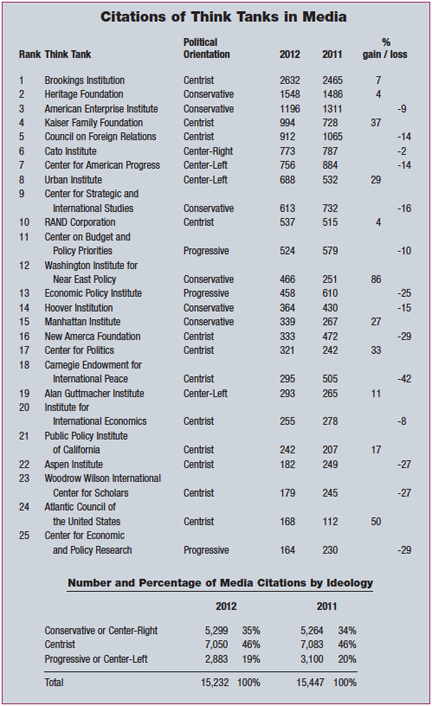
In 2013, Fairness & Accuracy in Reporting (FAIR) released its annual list of top think tank based on citations of those think tanks in the media. Think Tank Watch has mentioned the list before, but we have not dedicated an individual post to it, so here are the results:
- Brookings: 2,632
- Heritage Foundation: 1,548
- American Enterprise Institute (AEI): 1,196
- Kaiser Family Foundation: 994
- Council on Foreign Relations (CFR)
- Cato Institute: 773
- Center for American Progress (CAP): 756
- Urban Institute: 688
- Center for Strategic & International Studies (CSIS): 613
- RAND Corporation: 537
The think tank survey was conducted by sociologist Michael Dolny, who has been doing the think tank survey for FAIR since 1996.
A nice copy of the chart (as pictured above) can be found here.
Anne-Marie Slaughter: Rethinking the Think Tank
New America Foundation (NAF) President and CEO Anne-Marie Slaughter has just co-authored a piece with Ben Scott of NAF entitled "Rethinking the Think Tank." Here are some excerpts:
The authors go on to note that the past decades of growth and expansion in the think tank sector have resulted in an explosion or production of white papers. They say, however, that inevitably, think tanks reflect (and sometimes amplify) the partisanship, compartmentalization, and money in politics. She adds that even the best think tanks and think tankers are disconnected from the communities that the ideas are developed to serve.
The authors then tout NAF's own community engagement - Opportunity@Work, which they say researches the problem, prototypes solutions, tests them in the field with partners in companies and job centers, and accelerates the process of policy change by demonstrating what is possible.
She also calls out her own think tank, saying this:
Ben Scott, one of the co-authors, is a Senior Adviser to to NAF's Open Technology Institute (OTI). He is also a Visiting Fellow at the Stiftung Neue Verantwortung in Berlin, Germany.
More about Opportunity@Work, which was launched by NAF in March 2015, can be found here. Its co-founders are Byron Auguste (former Deputy Assistant to the President for Economic Policy and Deputy Director of the National Economic Council under President Obama) and Tyra Mariani (former Chief of Staff to US Deputy Secretary of Education in the Obama Administration).
Objective research from think tanks can still play an important role in federal policymaking. But the think tank as a policy institution has not adapted fast enough to escape the dysfunction of Washington. Even superb policy analysis seldom results in policy change. One reason is that expert positions in many debates are alien to the mobilized bases of both parties. Another is that the desire to score partisan points trumps the effort to get something done irrespective of whether the “right answer” is served up on a silver platter. Meanwhile, a plethora of specialized research institutions funded by trade associations, corporations, and partisan donors on both right and left have led many to question the objectivity of the policy positions adopted.
It is time to propose rethinking the think tank to meet these evolving challenges. The central mission is the same—to help solve public problems—but the form and function of the work must adapt. The theory of action of the traditional think tank is that change comes from the top-down adoption or abolition of laws and regulations. Papers and reports advocating specific changes are, of course, directly influenced by bottom-up political movements, from labor organizing to interest group coalitions. But the energy of such movements is typically harnessed to pass or block laws in a legislative process that is removed from direct engagement with people. Today, that model is too elitist, too narrow, and too slow.
We propose a new model of civic enterprise. “Civic” because it engages citizens as change makers—conscious members of a self-governing polity that expects government to be at least part of the solution to problems that individuals cannot solve on their own. And “enterprise” because of the energy and innovation involved in actually making change on the ground. Civic enterprise blends conventional policy research with local organizing, coalition building, public education, advocacy, and bottom-up projects that generate and test ideas before, during, and after engagement in the policymaking process with government.
The authors go on to note that the past decades of growth and expansion in the think tank sector have resulted in an explosion or production of white papers. They say, however, that inevitably, think tanks reflect (and sometimes amplify) the partisanship, compartmentalization, and money in politics. She adds that even the best think tanks and think tankers are disconnected from the communities that the ideas are developed to serve.
The authors then tout NAF's own community engagement - Opportunity@Work, which they say researches the problem, prototypes solutions, tests them in the field with partners in companies and job centers, and accelerates the process of policy change by demonstrating what is possible.
She also calls out her own think tank, saying this:
Even at an institution called New America, we look much more like old America: largely white, majority male, and almost entirely upper middle class. Think tanks operate with career ladders that recruit in elite universities, privilege advanced degrees, leverage political connections to move people up the ranks, and ultimately perpetuate institutions that look nothing like the rest of America. The problem is evident across the Washington policy ecosystem: the people most engaged in thinking, regulating, and legislating do not actually represent the citizenry.
Ben Scott, one of the co-authors, is a Senior Adviser to to NAF's Open Technology Institute (OTI). He is also a Visiting Fellow at the Stiftung Neue Verantwortung in Berlin, Germany.
More about Opportunity@Work, which was launched by NAF in March 2015, can be found here. Its co-founders are Byron Auguste (former Deputy Assistant to the President for Economic Policy and Deputy Director of the National Economic Council under President Obama) and Tyra Mariani (former Chief of Staff to US Deputy Secretary of Education in the Obama Administration).
Friday, November 6, 2015
Coolest Think Tank Studies Program
Bland think tank studies programs focusing on topics such as economics, foreign policy, immigration studies, and education policy abound at think tanks. Boring.
But do not fear all of you bon vivants, for the conservative think tank Competitive Enterprise Institute (CEI) probably has the coolest program around, and it is run by Michelle Minton, a Fellow at CEI and Director of "Sindustry Studies."
Yes, sindustry studies. Her Twitter description says that she fights for the right to eat, drink, gamble, and be merry.
In other words, she writes about beer, wine, liquor, soda, sugar, meat, doughnuts, junk food, Internet gambling, and even tampons. Where do we sign up?
We think that the program should join forces with what is probably the coolest corporate think tank in 2015: Absolut Labs. The brand director of that new think tank also happens to have the coolest think tank business card around.
But do not fear all of you bon vivants, for the conservative think tank Competitive Enterprise Institute (CEI) probably has the coolest program around, and it is run by Michelle Minton, a Fellow at CEI and Director of "Sindustry Studies."
Yes, sindustry studies. Her Twitter description says that she fights for the right to eat, drink, gamble, and be merry.
In other words, she writes about beer, wine, liquor, soda, sugar, meat, doughnuts, junk food, Internet gambling, and even tampons. Where do we sign up?
We think that the program should join forces with what is probably the coolest corporate think tank in 2015: Absolut Labs. The brand director of that new think tank also happens to have the coolest think tank business card around.
Thursday, November 5, 2015
Speaker Ryan and His Deep Think Tank Connections
For years Think Tank Watch has written about how Rep. Paul Ryan (R-WI) has been the darling of conservative think tanks, including the American Enterprise Institute (AEI) and to the Heritage Foundation. In fact, AEI's annual dinner in 2013 was solely meant to honor Rep. Ryan.
He is also close to scholars at the Hudson Institute and has had dinner with the head of American Action Forum. He has also spoken at the Center for a New American Security (CNAS) as well as the center-left think tank Brookings Institution.
Ryan has also spoken at state-level think tanks, including the Center of the American Experiment (in Minnesota). And he has embraced other think tanks outside of the beltway, such as the Manhattan Institute, which was reportedly advising some of his staff.
His think tanking is so prolific that during the 2012 vice presidential debates, Ryan was described as "Think Tank Ryan." Even David Hoppe, Ryan's new chief of staff, reportedly has connections with think tanks.
But Ryan's deep relationship with think tanks has not been all friendly. And his relationship with the Heritage Foundation is actually quite nuanced. For example, in 2013, Heritage Action, the lobbying arm of Heritage Foundation, came out against Ryan's budget plan.
As you may remember, former House Speaker John Boehner (R-OH) was often attacked by Heritage, and the think tank may have even helped destroy his career in Congress.
So the big question going forward is will Heritage play naughty or nice with Ryan. Heritage Action has recently said that it is time for "moving away from the US Chamber of Commerce's preferred agenda," and it will surely be watching Ryan closely.
He is also close to scholars at the Hudson Institute and has had dinner with the head of American Action Forum. He has also spoken at the Center for a New American Security (CNAS) as well as the center-left think tank Brookings Institution.
Ryan has also spoken at state-level think tanks, including the Center of the American Experiment (in Minnesota). And he has embraced other think tanks outside of the beltway, such as the Manhattan Institute, which was reportedly advising some of his staff.
His think tanking is so prolific that during the 2012 vice presidential debates, Ryan was described as "Think Tank Ryan." Even David Hoppe, Ryan's new chief of staff, reportedly has connections with think tanks.
But Ryan's deep relationship with think tanks has not been all friendly. And his relationship with the Heritage Foundation is actually quite nuanced. For example, in 2013, Heritage Action, the lobbying arm of Heritage Foundation, came out against Ryan's budget plan.
As you may remember, former House Speaker John Boehner (R-OH) was often attacked by Heritage, and the think tank may have even helped destroy his career in Congress.
So the big question going forward is will Heritage play naughty or nice with Ryan. Heritage Action has recently said that it is time for "moving away from the US Chamber of Commerce's preferred agenda," and it will surely be watching Ryan closely.
Wednesday, November 4, 2015
2016 Republicans Outsource Policy to Secret Group of Think Tankers
Although the John Hay Initiative (JHI) - which is made up of a variety of powerful think tankers and conservative insiders - is super-secretive and not well-known, it is the go-to source for Republican candidates to get foreign policy ideas and advice. Here is more from Josh Rogin:
Here is Josh Rogin's original piece about the John Hay Initiative. It says that the group is made up of more than 150 senior foreign policy and national security experts and former officials. Now, JHI says it has 250 experts. It was founded by three of the top leaders of the Romney 2012 foreign policy team: Eliot Cohen, Eric Edelman, and Brian Hook.
JHI recently released a book, dedicated to the next president of the United States, which "seeks to restore the bipartisan tradition of American leadership in world affairs."
The authors of the book include a number of think tankers, such as:
More about the John Hay Initiative can be found here.
There's a good reason so many GOP candidates seem to be well-prepared yet uncannily in sync when it comes to foreign policy: Most of them have tapped the same group of experts for guidance, a shadow foreign policy campaign infrastructure just waiting for a nominee to emerge.
Ever since Mitt Romney lost the race in 2012, his foreign policy team has been working to remain intact, become a resource for as many primary candidates as possible, and position itself to influence the next president, if he or she is a Republican. For candidates who haven't the time or resources to build their own foreign policy staffs at this stage, the project, called the John Hay Initiative, is a handy tool to get smart fast on complicated subjects and even hand off some heavy lifting on national security issues.
The co-founders say the group issues biweekly policy papers on a range of issues, does specific research for different campaigns on demand, and has briefed more than half of the 17 Republican candidates running for president. The Hay Initiative helped write recent foreign policy speeches for Carly Fiorina and Chris Christie, speeches that struck very similar notes. Members have also briefed Jeb Bush, Scott Walker, Marco Rubio, Ted Cruz, Lindsey Graham and others. Rand Paul and Donald Trump are the outliers who have no interaction with the group, likely because their foreign policy views don't jibe.
Here is Josh Rogin's original piece about the John Hay Initiative. It says that the group is made up of more than 150 senior foreign policy and national security experts and former officials. Now, JHI says it has 250 experts. It was founded by three of the top leaders of the Romney 2012 foreign policy team: Eliot Cohen, Eric Edelman, and Brian Hook.
JHI recently released a book, dedicated to the next president of the United States, which "seeks to restore the bipartisan tradition of American leadership in world affairs."
The authors of the book include a number of think tankers, such as:
- Elliot Abrams, Senior Fellow for Middle Eastern Studies at the Council on Foreign Relations (CFR).
- Dan Blumenthal, Director of Asian Studies at the American Enterprise Institute (AEI).
- Jacqueline Deal, Senior Fellow at the Foreign Policy Research Institute (FPRI).
- Paula Dobriansky, Senior Fellow with the Future of Diplomacy Project at Harvard University's JFK Belfer Center for Science and International Affairs
- Eric Edelman, a Distinguished Fellow at the Center for Strategic and Budgetary Assessments (CSBA).
- Aaron Friedberg, Non-Resident Senior Fellow at the German Marshall Fund (GMF) and a Senior Advisor to the National Bureau of Asian Research (NBR).
- Rebeccah Heinrichs, Fellow at the Hudson Institute.
- Will Inboden, Non-Resident Fellow at GMF.
- David Kramer, Senior Director for Human Rights and Democracy at the McCain Institute for International Leadership.
- Jeffrey Kupfer, Bernard Schwartz Fellow at the Asia Society Policy Institute.
- Clay Lowery, Visiting Fellow at the Center for Global Development (CGD) and Senior Advisor at the Center for Strategic and International Studies (CSIS).
- Wess Mitchell, Co-Founder of the Center for European Policy Analysis (CEPA).
- J. Peter Pham, Director of the Africa Center at Atlantic Council.
- Daniel Runde, Schreyer Chair in Global Analysis at CSIS.
- Michael Singh, Managing Director of the Washington Institute for Near East Policy (WINEP).
- Jim Talent, Senior Fellow at AEI.
More about the John Hay Initiative can be found here.
Subscribe to:
Posts (Atom)